brusselLs TRIBUNAL DOSSIER on Fallujah [PDF]
FLASHBACKS: Fallujah 1920: A history lesson about the town they have destroyed
It all started in april 2003, after the US invasion....
Fallujah: the April 2004 Siege (Jo Wilding)
Dahr Jamail's reports of the April 2004 Siege
List of Iraqi civilians killed in Fallujah in the assault on the city in April 2004
In memory of Fallujah (Inge Van De Merlen, 24 June 2006)
About the use of White Phosphorous. Click here to read more.
Recent news and articles about fallujah
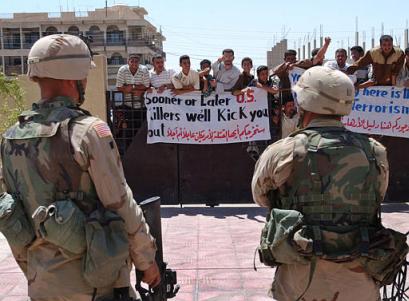

fotos: april 2003
JOHN PILGER: I think the resistance in Iraq is incredibly important for all of us. I think that we depend on the resistance to win, so that other countries might not be attacked, so that our world in a sense becomes more secure. Now, I don't like resistances that produce the kind of terrible civilian atrocities that this one has, but that is true for all resistances. And this one is a resistance against a rapacious power, that if it is not stopped in Iraq will go on to North Korea where Mr. Cheney and others are just chomping at the bit to have a crack at that country. So, what the outcome of this resistance is, is terribly important for the rest of the world. I think if the United States' military machine and the Bush administration can suffer a defeat in Iraq, they could be stopped. (Wednesday, December 31st, 2003)
A Bridge Across Tears For Iraq
A Statement of Solidarity in Suffering
 To the People of the World who profit from our tears
To the People of the World who care not of our tears
To the People of the World who know not of our tears
To the People of the World who live also with our tears
We speak to you, in whispers and in screams; in despair and in hope; in defeat and in struggle; to reclaim our humanity.
With the violated people of Iraq, we stand in solidarity, our arms joined in this bridge across tears.
We learn everyday of the killing, plunder, destruction and humiliation that takes place in Iraq.
We have heard the tired justifications of Power many times over - security, freedom, democracy, reconstruction - these are words that are not alien to us; they haunt us everyday as we tread upon our earths.
100,000 lives, of children, women and men, in Iraq have been the latest price to be paid for the betterment of civilisation.
Innocence is no protection. We know.
For each one of the 100,000 lives sacrificed at the altar of Power, united in death rests the remains of 100,000 more of our sisters and brothers of many names upon that same altar.
 The tanks, the bullets, the airstrikes, the depleted uranium, the torture, the collective punishments, these that have been the weapons of vengeance against the people of Iraq, are all kin to the hunger, the destitution, the 'structural adjustment programmes', the poisoned rivers and lands, the suffocating clouds of 'progress', the police truncheon, the barbed wires, that have been and are our scourge.
We name all as violation.
As we shed our tears for our losses, our tears fall also on the lands of Iraq.
Though Power seeks to blind us with their lies, our eyes remain ablaze with the fire of life that we carry of all our dead.
And we denounce Power with its many faces of violence.
For theirs is not a 'Security' in which we are secure.
Theirs is not a 'Freedom' in which we are free.
 Theirs is not a 'Civilisation' in which we are dignified as humans.
This we say as we build a Bridge Across Tears:
To Power:
We notify you that we, the peoples of the global south, stand together with the people of Iraq in resisting your cruelty. Be aware.
We demand of the US-UK led 'Coalition' the cessation of violence against the people of Iraq, the withdrawal of all the occupying forces from Iraqi lands, and the restoration of the will of the Iraqi people for genuine self-determination.
We demand that those who call themselves leaders of nations act as leaders in halting the impunity of the Occupation in Iraq by mobilising themselves against the US-UK led 'Coalition' in Iraq.
We demand of the United Nations immediate action to withdraw support for the on-going Occupation of Iraq, and to initiate an international process of judgement against the illegal and criminal use of force against the people of Iraq.
 We affirm our common humanity in struggle, with the people of Iraq against the invading forces, and with sisters and brothers everywhere against the invasions upon their lives, livelihoods and dignity.
We pledge that ours is a common struggle for peace, justice and humanity.
To the People of the World,
We call on you to be a Bridge Across Tears so that Humanity may prevail over the cruelties of Power.
Jayan Nayar
Coordinator
Peoples' Law Programme
 I Am Fallujah
I am Fallujah.
Once before I endured the colonial arrogance
of another nation
upon my soil.
That was 87 years ago,
and with their superior weapons,
they, too, came to liberate us.
I cried out.
I warned them
that I would not endure
an uninvited presence.
The Empire thought
my people ignorant.
And now, under a different flag, you strike with the precision of deranged camel,
your weapons missing your stated target
again and again,
all the while knowing
your real target
is complete conquest.
You screamed when my people vented their rage upon one or two of your suited predators.
With false indignation, you summoned your weapons of mass destruction while truckloads of our dead rumbled past your snipers to a lonely mass burial.
Sometimes you even shot at the drivers.
And when my people reported the downfall of another child, another family
in one of your precision strikes
you claimed they lied,
they exaggerated,
they falsified the facts.
Do they exaggerate today when a pall of ten thousand
misinformed soldiers enter their city
with homicidal rules of engagement?
Have you told your own people that those orders include
shooting surrendering citizens on sight?
And still you use the language of benevolence.
You promote the dubious presence of a sinister entity
to re-direct world attention
through your selective, rhetorical lens.
Zarqawi, Zarqawi, Zarqawi you chant
as you handsomely reward your media servants
for their silence.
Yet you dare not acknowledge that with each death,
you induce the birth of another fighter.
With each bomb,
the hatred of your colonial ambition grows.
And around the world, with every drop of blood you cause,
you feed reaction and backwardness the very food it needs
to sabotage the aspirations of the worlds people.
The true freedom from oppression you so cynically claim to champion.
To meet your ends, you consciously blur the distinction between terrorist and insurgent.
The terrorist is your ally, although you call him enemy.
The terrorist is the veil behind which your blood encrusted nails
attempt to gouge out the clear vision of humanity.
The terrorist is your very own Frankenstein monster
forged in the laboratories of your foreign policy.
The insurgent simply fights to be free - of you,
a searing resistance born from the fires of scorned dignity.
While your craven campaign
may momentarily subdue those who survive,
you shall neither defeat them, nor befriend them,
for the tincture of time
will barely soothe the memories
of such atrocities as yours.
I am Fallujah. I am all cities under imperialist siege.
We have fought you before.
We know what motivates you.
We know your eyes.
They reflect the barrels of black poison
that have drained you of decency.
And in your murderous pursuit of plundered profits,
you stand to condemn all of our children
to a lifetime of intellectual and emotional anguish.
Remember this: we did not invite you into our house.
When you claim the mantle of nobility,
know that it is in infamy your legacy will find its home.
Fallujah invaded by US forces on November 9th 2004
Jenny Campbell 12 Nov 2004 03:52 GMT
http://newswire.indymedia.org/en/newswire/2004/11/814131.shtml
This poem was written a few days before the invasion began and updated it the day of the invasion. May it circulate widely!
Freedom carol
Nedhal Abbas*
Ah
I'll say it again:
There are few things
On which we all agree;
Sooner or later
You'll be free.
Democracy is new for you
But never mind
We will teach you
Marines;
Move forward
Go on
This is what you trained for
You are the hunter
You are the predator
Freedom is beautiful
Do you hear?
Soldiers march,
On natives bodies
Battling a stench
They chant
Freedom is beautiful
By tanks
By warplanes,
Apache, Kiowa, marine cobra.
Smoke grenades
By Sniper shots
We'll end your demise
They deliver.
Wrapped in democracy,
Coloured in freedom,
Packages of
Un- named mutilated naked burned
Blown apart un-counted bodies
We receive
137,000
Men women and children
Mohamed, Ali, Omar, Jawad
Selma, Nadia, Fatima, Suhad
Hussein, Ahmed, Salam, Azad
Aysha, Amal, Maysoon, Nuhad
Faisal, Raad, Zaid, Widad
Nuha, Haifaa, Kifah, Souad
From a distance'
Chorus of freedom recite:
Ah
We'll say it again;
Can't you understand?
It's our mission
To put an end
To your demise.
Nedhal Abbas: Iraqi poet. She published her first book of poetry "Dreams of invisible pleasures", in Arabic, in 1999.
This poem has been translated by Haifa Zangana. (first published on http://www.idao.org/freedom-carol.html )
Fallujah: Shock and Awe
Ken Coates, Bertrand Russell Peace Foundation.
It was on April 26th 1937 that the name of Guernica was immortalised. A little town, home to 7000 people, Guernica was the local market place for a cluster of hill villages. It straddled a valley only ten kilometres from the sea, and thirty from Bilbao. It was a cultural centre for the Basque country, with a hallowed oak tree upon which for centuries the public power in Spain has been obliged recurrently to affirm an oath to respect the rights of the Basque people.
April 26th was a Monday, market day. It went ahead peaceably, although the Civil War was raging thirty kilometres away. The air raid was not announced (by an urgent call from the Church bells) until half past four in the afternoon. Ten minutes later Heinkels arrived, scattering their bombs across the town, and then machine gunning the streets. Following the Heinkels came the Junkers. The German Air Force was celebrating a major practice run. When the people ran away, they, too, were machine-gunned. One thousand six hundred and fifty-four people were killed, and eight hundred and eighty-nine were wounded. The town centre was destroyed, and Europe received its first baptism of aerial bombardment on a modern scale.
The shock reverberated far beyond the Basque country. Spain was not a remote colony like Iraq, from which news could take an age to travel. Within a week Picasso began his painting, his masterpiece which is at present installed in a special gallery attached to the Prado. In preparation for this, he feverishly prepared a desperately poignant series of sketches and cartoons, one of which we feature on our cover. Picasso gave us a portrait of naked horror. Europe was soon to learn the face of that horror at first hand. It is said that when some German officers visited Picasso in his studio in occupied France, they said of Guernica, drawings from which were hung in the room, “Did you do this?” The master is said to have replied: “No, you did”.
But it was not only the German Air Force which tore away at the fabric of European cities. Coventry and London pale into insignificance when compared with Hamburg and Dresden. It was an American soldier, Kurt Vonnegut, who was to create a memorial to Dresden, in his extraordinary work Slaughterhouse Five. Slaughterhouses, since, we have seen in profusion. Before the incineration of Hiroshima and Nagasaki, there was the massive “conventional” air raid on Tokyo which killed many tens of thousands of people. Then we lived through the Cold War, and the nuclear arms race, until we entered, with the collapse of the Soviet Union, into the age of Full Spectrum Dominance from Washington. Now the centre of that domination sits in Iraq, and for the time being the carnage radiates out from the city of Falluja.
We are told that Falluja had to be destroyed, in order to carry out elections to an Iraqi constituent assembly on the 27th January 2005. We will see whether any elections take place. There are those among us who doubt whether such elections were actually intended in any more than a fictional exit strategy for the purposes of another election, in the United States. Mr. Bush has won that, and may not need the one in Iraq. It is greatly to be doubted whether the conditions for an election exist in the aftermath of the destruction of Falluja.
Kofi Annan warned Bush, Blair, and their puppet, Iyad Allawi, that elections required “a broader spectrum of Iraqis to join the political process” and the persuasion of “elements who are currently alienated from, or sceptical about, the transition process”. He expressed his “increasing concern at the prospect of an escalation in violence, which I fear could be very disruptive for Iraq’s political transition”.
Kofi Annan was entirely specific.
“I have in mind not only the risk of increased insurgent violence, but also reports of major military offensives being planned by the multinational force in key localities such as Falluja. I wish to express to you my particular concern about the safety and protection of civilians. Fighting is likely to take place mostly in densely populated urban areas, with an obvious risk of civilian casualties … The threat or actual use of force not only risks deepening the sense of alienation of certain communities, but would also reinforce perceptions among the Iraqi population of a continued military occupation.”
Guernica was struck down out of a clear sky, and none of the victims expected it. But Falluja was planned in great detail for months before the culmination of the American election made it possible to risk the criticism of domestic public opinion. Indeed the British allies were redeployed to seal off what was eloquently described as the “rat run” from Falluja, in spite of the consternation in Scotland, whose Black Watch soldiers were put at very dire risk. All that took time. It took time, up to two months, to cut off the water supplies to Tall Afar, Samarra, and Falluja. We publish in our dossier a careful report by Cambridge Solidarity with Iraq, which describes how this was done, in breach of international humanitarian law, and without consultation with any of the allies. Towards the end of a week of remorseless bombing and bombardment, the Red Crescent succeeded in sending a convoy of food and medicines into the outskirts of Falluja. American forces denied them the right to move beyond a hospital on the outskirts of the town.
As happened before, during the invasion by coalition forces, news has been comprehensively and carefully managed, so that we cannot tell what the true level of casualties has been. At the end of the first week, the Americans were reported as having sustained 38 deaths and to have suffered 275 other casualties. They also claim to have killed, variously, 1000 or 1600 insurgents and to have captured between 450 and 550 others. But the insurgents claim vastly smaller casualties. Al-Dulaimi said that the number of Falluja’s defenders, “martyrs who were killed”, did not exceed 100. “We lost 15 of our men”, he said. Nobody, but nobody, can offer any credible figures about the civilian death toll. We shall not be able to calculate anything approaching the true mortality for some time, just as it took more than a year before The Lancet was able to publish research about the true human cost of the occupation.
What is absolutely clear is that large swathes of Falluja have been literally pulverised, ground to powder by the kind of destructive machine that Hermann Goering could hardly imagine. Just as we do not know how many innocents have been massacred, neither do the Iraqi people. But they know about the moral depth of this atrocity. They know that Iraqi lives do not count for the coalition, nor for its servants in the Iraqi detachments of American intelligence, who now call themselves Ministers.
The highest Shia authority in Baghdad, Shaikh Muhammad Mahdi al-Khalissi, condemned the assault on Falluja as an “aggression and dirty war”, and said:
“No matter how powerful the occupation forces are, they will be driven out of Iraq sooner or later. The current savage military attack on Falluja by US occupation forces and the US appointed Iraqi Government is an act of mass murder and a crime of war”.
The Association of Muslim Scholars, a Sunni powerhouse, proclaimed a Fatwa prohibiting Iraqis from joining in the American attack. Muqtada al-Sadr withdrew the support of his movement for the January elections. His aide declared:
“There has been a chance for a peaceful solution, but the Government always chooses the military solution because the United States wants that”.
Meantime, open insurgency rages in Kirkuk, Tikrit, Samarra, Baiji, and in Iraq’s third largest city, Mosul. Other towns have given refuge to fighters fleeing from Falluja itself, as has Ar Ramadi.
The official story put out by the coalition is that strong contingents of foreign fighters and supporters of the old regime constitute tightly knit minorities who can be hunted down, to the relief of the majority of peace loving Iraqis. The destruction of Falluja will destroy this myth. The American occupation stands revealed, red in tooth and claw. It does not intend to go away It would like to establish economically viable bases, for sure, and to withdraw many soldiers for deployment elsewhere. But it does not intend to relinquish control of the resources it had thought it had won. Oil remains very high on the agenda.
Quite why Tony Blair supports these brigands is very difficult to understand. There may not be many spoils of war for him. But he has earned a due share of the opprobrium which attaches to war criminals. A brave attempt to impeach him has been made on the initiative of Plaid Cymru’s MP Adam Price, and we have published the magisterial indictment prepared by Glen Rangwala and Dan Plesch. The impeachment concerns the lies that were told in preparation for the invasion. More lies are following all the time, and they are more desperately told, as the truth about this illegal war, and this incredibly brutal occupation, begins to make itself plain. Unlike President Bush, the Prime Minister’s election is in front of him. It is difficult to see how anyone with a conscience will be able to support the renewal of his mandate.
Editorial: The Spokesman no.84, Journal of the Bertrand Russell Peace Foundation (www.russfound.org)
 This Night In Fallujah: Lailat Al Qadr In Ramadan
© Copyright 2004 Sam Hamod
Tonight, in Fallujah
We wait
For the known
For the follow-up
To the fighter planes
To the rockets
To the long days of shelling
To the depleted uranium killing us slowly,
We wait
To see their tanks
Their tanks will come first
They remind us of the Israelis
They remind us American planes killed our cousins
In Palestine
Killed them with American rockets,
Now
They have come for us
We were living
Just living our lives,
With our wives and children,
Just like the Americans
They went to school, they did their lessons
They ran innocently
In the schoolyards
And on weekends the boys
Would tease the girls
In the marketplace, but
Dare not let the mother or
Father of the girl see, the girls
Would twist their
Hair, their smiles
And blush
Away from the eyes
Of their mothers
We were just living
Not looking to fight, just
Wanting to be
Left alone
But they came
Hunting us, like
Animals, like wild
Things, they came
Shooting, randomly,
Dropping 500 pound bombs
Destroying our mosques, our
Churches, our schools, our
Hospitals, our water, our
Electricity—they bombed
Us back 300 years
But, we
Just wanted to live
Just wanted to pray each day
In our mosques, raise our
Children, take care of our
Wives, our old fathers and
Mothers, we are not for
Fighting—but now
There is no
Choice—what good
Would it be to run
To be shot down
Like an animal on the run,
Now it is time, even with
The small weapons
We have, we shall stand now
To protect what we have
To claim our own homes, to claim
Our own peace
They are strange
These Christians, not like
My cousin’s wife
Who is Christian, in our
Christian churches, they say
Jesus said, “Blessed are the peacemakers,”
“God’s greatest gift is mercy,”
but these men come
with large crosses on their chests,
their ministers teach them songs about
killing and killing for Jesus, these
Americans are strange, we had
Always heard
They were peaceful people, people
Who wanted what we wanted,
Peace, life, justice,
Decency, education,
We had heard----
So now they come,
Loudspeakers on their jeeps, loudspeakers
And louder music, drums banging,
They tell us to surrender or die, they have
Iraqi slaves among them, some of whom
Will, at the last minute, turn on these
Americans, kill some
And themselves be killed,
We have on our side, Allah
We have on our side, our families,
Our homes, our thousands of years
Of having to defend ourselves
From Persians, from Greeks, from
Romans, from Mongols, from Crusaders,
From Turks, from British—now
This new evil, this new devil
Flying their flags, red, white and blue,
Blaring their music and harsh words,
We see their eyes now,
They are young, like
Us, they are afraid, yet
They want to kill us, we
Are “ragheads,” “we are animals,”
We are “assholes,” “we are terrorists”
And every other name you can think of
And they have come to kill us
To wipe our city off the maps of the world,
Off the map of Iraq, they say
They come at the order of the exile
The Americans sent to rule us, Iyad
Allawi, Iyad the whore, Iyad the munafik,
Iyad the devil—and yes,
We shall die, but Allah knows
Who is the evil one
And who is the one who fights in his name,
There is always that short term victory
For the devils
But their long run is not long
And they too shall die
We do not want to die, but
We understand dying is only
Part of living, death is always
Waiting, sometimes
Patiently, other times
Takes us swiftly, but we understand
This is the will of Allah
Some of us must die
So that others will
Understand
Just what is going on
So that others will see
So that others will resist even more
Our deaths will echo in Saudi Arabia,
In Kuwait, in the Muslim halls of the world, in
The cries of our women, in the history of our
Muslim people, in the Khutba’s on Friday’s
Prayers—they know
That we die during Ramadan, they know
We die gloriously at the hand of the heathens, at
The hands of the unbelievers, for the sake of
What the Qur’an taught us,
To protect our families, our homes, our country and
Most of all to protect our mosques
And Islam
So we have stayed to fight
And die during Ramadan, this
Most holy of months, this Ramadan
That requires so much
Discipline and faith, this Ramadan
That is the month of our sign of commitment
To Allah, it is a glorious month
In which to fight, and if necessary
To die
No, we are not mad
We do not wish to die
We have more desire to live
Than these devils who have invaded our land
Attacked our fathers and mothers, who
Have raped our women, who have
Tortured our cousins and brothers in their
Prisons, all in the name of
“democracy,” and “liberty,” and “freedom”—
how hollow their words
how hollow their lies
how hollow their attacks on us
they do not realize
we do not die, we
live, we live
on now, as martyrs, as
heroes, as men who
were not afraid to die, as men
who believed in the Deen, in Allah,
in the same God they proclaim but do not truly follow—
but his wrath is coming
his wrath shall be coming upon them—
if they survive our fight, they
are being poisoned, just as we have been poisoned,
the depleted uranium has poisoned their blood,
has poisoned the eggs in their sperm,
has poisoned their lives
so when they have deformed children, the
children will be witnesses to their killing
us, to their killing of their own souls,
to their killing their own families, and
what of those who will go mad, whose
nightmares will not let them ever sleep
another peaceful night
and what will their faces tell them
when they look in the mirror
when they look on their dressers
and see the pieces of metal
they were given for killing us
in our own homes, in own cities, in
our own mosques and churches,
what will their eyes say,
what will they say when their twisted
lies are uncovered, when the rest of the
world speaks of their massacres of
women and children, of old men, of
bombing hospitals, what will they
do when they see the smirking face
of their presidents, their senators, their
leaders who have allowed them to do this,
have ordered them to do this
—and
what will they say to Jesus
when he speaks to them on Judgement Day
when he asks why they killed—
why they did not say, NO
why they did not prefer prison over killing of innocent
civilians, and to the pilots who
fly freely, without concern of any reprisal, F16s rocketing
our city day after day, night after night, surely
they will not fly with the angels, but
shall burn even worse than the rest—
and so we hear the rockets and hear the bombs
during our maghrib prayer, we have heard since our fajr
prayers, we do not much feel like iftar, the food
has lost some of its taste, no one wants to die,
no one wants to leave their wife and children,
no one wants never to see their father or mother again,
no one wants to have to fight, just to live,
no one wants to have to kill another human being—at least
none of us,
we were living peacefully in our city,
we did not attack anyone, we
did not do anything worse than defend ourselves,
and for that
now we know we must die, we
know that unless Allah produces a miracle
or sends legions of angels to protect us
that the planes will attack
with the tanks that will crush us
with the rockets and snipers who
will split our bodies into pieces, whose
concussions will split our heads open,
whose noise will puncture our eardrums
until we bleed
and like our blessed Prophet Jesus, who came
before our blessed Prophet Muhammad, peace be upon him,
we shall die, just as Jesus
was martyred—we shall be martyred
by the new Roman, the new crusader army,
on this Night of Power, where Allah’s message of
righteousness and courage is clear, where
we renew our commitment to our God,
where we know he gives us everlasting life
though we may die tonight on the earth,
we shall live forever, in Allah’s hands,
We shall live
in history, and the world, yea
the world will remember
we stood and fought this day,
knowing we would die
but knowing that death is only a moment
in God’s time, in Allah’s time
and that those who kill us today
may live long and tortured lives
when they realize what evil they have done
and those evil men
who ordered them on, Allawi, Bush,
Cheney, Wolfowitz, Abizaid, Myers and the rest,
Allah will take care of them
On the earth and on Judgement Day,
And the men who did not have the courage to
Say, No,
They will suffer each hour, each day
For the rest of their earthly days,
For it is written, that whosoever kills a believer
During Ramadan, will suffer hellfire and damnation
For eternity
So we choose to stand, to die if we must,
But during this blessed month of Ramadan
There is no death to the believer
Only the knowledge that Allah’s ways
Are beyond our understanding—we may not
Be on the earth to see what will happen
but we will be looking
Down from Heaven
And we shall see Allah visit his wrath
On those who come to kill us in our homes,
In our city, in our country, in our churches, in
Our mosques—and though we may die,
Like these days of our battle,
Our spirits
Will live forever
------------------------------------------------------------------------------------------------
Lailat Al Qadr: The Night of Power where God’s message is clear to the world, where God/Allah blesses the righteous and condemns the evil ones.
Ramadan: The Muslim Holy Month of fasting, prayer and renewed commitment to God/Allah (Allah is the Arabic word for God, used by Muslims and Christians alike in the Middle East).
Qhutba: The Muslim sermon on prayer days in the mosques.
Fallujah: The homecoming and the homeless
By Patrick Cockburn in Baghdad and Kim Sengupta
http://news.independent.co.uk/world/middle_east/story.jsp?story=591998
11 December 2004
The Black Watch arrives back in Britain this morning home in time for Christmas as Tony Blair had promised.
The regiment's five-week mission the toughest British troops have faced since the invasion of Iraq 21 months ago made possible the US assault on Fallujah, which now lies in ruins. Five Black Watch soldiers died, and no one doubts the dedication they brought to the task, particularly as the regiment knew it was facing the axe in a forthcoming review of the Army.
As they left Camp Dogwood for the last time yesterday, one officer spoke of the frustration among the 850-strong contingent when it was ordered north to support the American forces. He said: "The whole deployment was, of course, heavily politicised from the beginning. Some soldiers criticised Tony Blair by name. There was a feeling that we were being used, and that made it difficult to focus initially on our mission."
They are delighted to be back home, and will no doubt enjoy emotional reunions with their families. But what of the mission they left behind, and the city that was its target? Yesterday, the first independent reports began to emerge from a flattened city which is facing an unprecedented, permanent security crackdown, and an uncertain future.
The assault by 10,000 US troops began on 8 November, just after the US presidential elections: its aim, to clear a city regarded by the Americans as a hotbed of insurgency.
More than 70 marines died, and 1,600 rebels. But no one knows the civilian casualty toll this in a city which once numbered 300,000. Indeed, there are no estimates of how many people are still there, or how many escaped to neighbouring towns and to Baghdad before the assault got under way.
Ahmed Rawi, a Red Cross spokesman, said yesterday: "No one knows how many families are inside the city." The Red Cross team which entered without escort and left before curfew met no residents, apart from engineers and technicians. The Red Cross reported that hundreds of dead bodies remain stacked inside a potato chip warehouse on the outskirts. Some of the bodies were too badly decomposed to be identified. Raw sewage runs through the streets.
All this, and there are no humanitarian workers working inside the city. When the first of Fallujah's refugees are allowed to return on Christmas Eve, they will be funnelled through five checkpoints. Each will have their fingerprints taken, along with DNA samples and retina scans. Residents will be issued with badges with their home addresses on them, and it will be an offence not to wear it at all times. No civilian vehicles will be allowed in the city in an effort to thwart suicide bombers. One idea floated by the US is for all males in Fallujah be compelled to join work battalions in which they will be paid to clear rubble and rebuild houses.
American officers say the hardline approach is legal under martial law regulations issued last month by the interim government of Iyad Allawi. But they appear a little embarrassed by the Orwellian overtones of their plan. Major Francis Piccoli, a spokesman for the 1st Marine Expeditionary Force, admitted: "Some may see this as a 'Big Brother is watching over you' experiment. But, in reality, it's a simple security measure to keep the insurgents from coming back."
Before the battle of Fallujah, the US repeatedly said that foreign fighters and Islamic zealots were orchestrating guerrilla attacks on US soldiers from the city. But the planned measures presume everybody in Fallujah to be a potential supporter of the resistance.
Fallujah will be the first community in Iraq to be subjected to such tough identification tests. So far, they have been used mainly against detainees there are 2,000 people still held on suspicion of aiding the insurgents.
The city's capture was supposed to break the back of the insurgency and open the way for people to take part in the Iraqi elections on 30 January. Yet, so far, there is little sign that resistance to the US and the interim government is weakening in Sunni Muslim districts in central and northern Iraq.
The plan to identify and monitor all civilians is very similar to a plan implemented by Saddam Hussein to separate insurgents from civilians in Iraqi Kurdistan during the 1980s.
Against all this background, the officer from the Black Watch said as he prepared to leave: "Was it worth it? Of course, we have all got our private thoughts about this war. There was a lot of unease about being identified too much with the Americans and Fallujah ... you have to hope at the end that we did some good. Only time will tell."
Fallujah: the April 2004 Siege
by Jo Wilding (April 14 2004)
I’m sorry it’s so long, but please, please read and forward widely. The truth of what’s happening in Falluja has to get out.
Hamoudie, my thoughts are with you.
April 11th Falluja
Trucks, oil tankers, tanks are burning on the highway east to Falluja. A stream of boys and men goes to and from a lorry that’s not burnt, stripping it bare. We turn onto the back roads through Abu Ghraib, Nuha and Ahrar singing in Arabic, past the vehicles full of people and a few possessions, heading the other way, past the improvised refreshment posts along the way where boys throw food through the windows into the bus for us and for the people inside still inside Falluja.
The bus is following a car with the nephew of a local sheikh and a guide who has contacts with the Mujahedin and has cleared this with them. The reason I’m on the bus is that a journalist I knew turned up at my door at about 11 at night telling me things were desperate in Falluja, he’d been bringing out children with their limbs blown off, the US soldiers were going around telling people to leave by dusk or be killed, but then when people fled with whatever they could carry, they were being stopped at the US military checkpoint on the edge of town and not let out, trapped, watching the sun go down.
He said aid vehicles and the media were being turned away. He said there was some medical aid that needed to go in and there was a better chance of it getting there with foreigners, westerners, to get through the american checkpoints. The rest of the way was secured with the armed groups who control the roads we’d travel on. We’d take in the medical supplies, see what else we could do to help and then use the bus to bring out people who needed to leave.
I’ll spare you the whole decision making process, all the questions we all asked ourselves and each other, and you can spare me the accusations of madness, but what it came down to was this: if I don’t do it, who will? Either way, we arrive in one piece.
We pile the stuff in the corridor and the boxes are torn open straightaway, the blankets most welcomed. It’s not a hospital at all but a clinic, a private doctor’s surgery treating people free since air strikes destroyed the town’s main hospital. Another has been improvised in a car garage. There’s no anaesthetic. The blood bags are in a drinks fridge and the doctors warm them up under the hot tap in an unhygienic toilet.
Screaming women come in, praying, slapping their chests and faces. Ummi, my mother, one cries. I hold her until Maki, a consultant and acting director of the clinic, brings me to the bed where a child of about ten is lying with a bullet wound to the head. A smaller child is being treated for a similar injury in the next bed. A US sniper hit them and their grandmother as they left their home to flee Falluja.
The lights go out, the fan stops and in the sudden quiet someone holds up the flame of a cigarette lighter for the doctor to carry on operating by. The electricity to the town has been cut off for days and when the generator runs out of petrol they just have to manage till it comes back on. Dave quickly donates his torch. The children are not going to live.
“Come,” says Maki and ushers me alone into a room where an old woman has just had an abdominal bullet wound stitched up. Another in her leg is being dressed, the bed under her foot soaked with blood, a white flag still clutched in her hand and the same story: I was leaving my home to go to Baghdad when I was hit by a US sniper. Some of the town is held by US marines, other parts by the local fighters. Their homes are in the US controlled area and they are adamant that the snipers were US marines.
Snipers are causing not just carnage but also the paralysis of the ambulance and evacuation services. The biggest hospital after the main one was bombed is in US territory and cut off from the clinic by snipers. The ambulance has been repaired four times after bullet damage. Bodies are lying in the streets because no one can go to collect them without being shot.
Some said we were mad to come to Iraq; quite a few said we were completely insane to come to Falluja and now there are people telling me that getting in the back of the pick up to go past the snipers and get sick and injured people is the craziest thing they’ve ever seen. I know, though, that if we don’t, no one will.
He’s holding a white flag with a red crescent on; I don’t know his name. The men we pass wave us on when the driver explains where we’re going. The silence is ferocious in the no man’s land between the pick up at the edge of the Mujahedin territory, which has just gone from our sight around the last corner and the marines’ line beyond the next wall; no birds, no music, no indication that anyone is still living until a gate opens opposite and a woman comes out, points.
We edge along to the hole in the wall where we can see the car, spent mortar shells around it. The feet are visible, crossed, in the gutter. I think he’s dead already. The snipers are visible too, two of them on the corner of the building. As yet I think they can’t see us so we need to let them know we’re there.
“Hello,” I bellow at the top of my voice. “Can you hear me?” They must. They’re about 30 metres from us, maybe less, and it’s so still you could hear the flies buzzing at fifty paces. I repeat myself a few times, still without reply, so decide to explain myself a bit more.
“We are a medical team. We want to remove this wounded man. Is it OK for us to come out and get him? Can you give us a signal that it’s OK?”
I’m sure they can hear me but they’re still not responding. Maybe they didn’t understand it all, so I say the same again. Dave yells too in his US accent. I yell again. Finally I think I hear a shout back. Not sure, I call again.
“Hello.”
“Yeah.”
“Can we come out and get him?”
“Yeah,”
Slowly, our hands up, we go out. The black cloud that rises to greet us carries with it a hot, sour smell. Solidified, his legs are heavy. I leave them to Rana and Dave, our guide lifting under his hips. The Kalashnikov is attached by sticky blood to is hair and hand and we don’t want it with us so I put my foot on it as I pick up his shoulders and his blood falls out through the hole in his back. We heave him into the pick up as best we can and try to outrun the flies.
I suppose he was wearing flip flops because he’s barefoot now, no more than 20 years old, in imitation Nike pants and a blue and black striped football shirt with a big 28 on the back. As the orderlies form the clinic pull the young fighter off the pick up, yellow fluid pours from his mouth and they flip him over, face up, the way into the clinic clearing in front of them, straight up the ramp into the makeshift morgue.
We wash the blood off our hands and get in the ambulance. There are people trapped in the other hospital who need to go to Baghdad. Siren screaming, lights flashing, we huddle on the floor of the ambulance, passports and ID cards held out the windows. We pack it with people, one with his chest taped together and a drip, one on a stretcher, legs jerking violently so I have to hold them down as we wheel him out, lifting him over steps.
The hospital is better able to treat them than the clinic but hasn’t got enough of anything to sort them out properly and the only way to get them to Baghdad on our bus, which means they have to go to the clinic. We’re crammed on the floor of the ambulance in case it’s shot at. Nisareen, a woman doctor about my age, can’t stop a few tears once we’re out.
The doctor rushes out to meet me: “Can you go to fetch a lady, she is pregnant and she is delivering the baby too soon?”
Azzam is driving, Ahmed in the middle directing him and me by the window, the visible foreigner, the passport. Something scatters across my hand, simultaneous with the crashing of a bullet through the ambulance, some plastic part dislodged, flying through the window.
We stop, turn off the siren, keep the blue light flashing, wait, eyes on the silhouettes of men in US marine uniforms on the corners of the buildings. Several shots come. We duck, get as low as possible and I can see tiny red lights whipping past the window, past my head. Some, it’s hard to tell, are hitting the ambulance I start singing. What else do you do when someone’s shooting at you? A tyre bursts with an enormous noise and a jerk of the vehicle.
I’m outraged. We’re trying to get to a woman who’s giving birth without any medical attention, without electricity, in a city under siege, in a clearly marked ambulance, and you’re shooting at us. How dare you?
How dare you?
Azzam grabs the gear stick and gets the ambulance into reverse, another tyre bursting as we go over the ridge in the centre of the road , the sots still coming as we flee around the corner. I carry on singing. The wheels are scraping, burst rubber burning on the road.
The men run for a stretcher as we arrive and I shake my head. They spot the new bullet holes and run to see if we’re OK. Is there any other way to get to her, I want to know. La, maaku tarieq. There is no other way. They say we did the right thing. They say they’ve fixed the ambulance four times already and they’ll fix it again but the radiator’s gone and the wheels are buckled and se’s still at home in the dark giving birth alone. I let her down.
We can’t go out again. For one thing there’s no ambulance and besides it’s dark now and that means our foreign faces can’t protect the people who go out with us or the people we pick up. Maki is the acting director of the place. He says he hated Saddam but now he hates the Americans more.
We take off the blue gowns as the sky starts exploding somewhere beyond the building opposite. Minutes later a car roars up to the clinic. I can hear him screaming before I can see that there’s no skin left on his body. He’s burnt from head to foot. For sure there’s nothing they can do. He’ll die of dehydration within a few days.
Another man is pulled from the car onto a stretcher. Cluster bombs, they say, although it’s not clear whether they mean one or both of them. We set off walking to Mr Yasser’s house, waiting at each corner for someone to check the street before we cross. A ball of fire falls from a plane, splits into smaller balls of bright white lights. I think they’re cluster bombs, because cluster bombs are in the front of my mind, but they vanish, just magnesium flares, incredibly bright but short-lived, giving a flash picture of the town from above.
Yasser asks us all to introduce ourselves. I tell him I’m training to be a lawyer. One of the other men asks whether I know about international law. They want to know about the law on war crimes, what a war crime is. I tell them I know some of the Geneva Conventions, that I’ll bring some information next time I come and we can get someone to explain it in Arabic.
We bring up the matter of Nayoko. This group of fighters has nothing to do with the ones who are holding the Japanese hostages, but while they’re thanking us for what we did this evening, we talk about the things Nayoko did for the street kids, how much they loved her. They can’t promise anything but that they’ll try and find out where she is and try to persuade the group to let her and the others go. I don’t suppose it will make any difference. They’re busy fighting a war in Falluja. They’re unconnected with the other group. But it can’t hurt to try.
The planes are above us all night so that as I doze I forget I’m not on a long distance flight, the constant bass note of an unmanned reconnaissance drone overlaid with the frantic thrash of jets and the dull beat of helicopters and interrupted by the explosions.
In the morning I make balloon dogs, giraffes and elephants for the little one, Abdullah, Aboudi, who’s clearly distressed by the noise of the aircraft and explosions. I blow bubbles which he follows with his eyes. Finally, finally, I score a smile. The twins, thirteen years old, laugh too, one of them an ambulance driver, both said to be handy with a Kalashnikov.
The doctors look haggard in the morning. None has slept more than a couple of hours a night for a week. One as had only eight hours of sleep in the last seven days, missing the funerals of his brother and aunt because he was needed at the hospital.
“The dead we cannot help,” Jassim said. “I must worry about the injured.”
We go again, Dave, Rana and me, this time in a pick up. There are some sick people close to the marines’ line who need evacuating. No one dares come out of their house because the marines are on top of the buildings shooting at anything that moves. Saad fetches us a white flag and tells us not to worry, he’s checked and secured the road, no Mujahedin will fire at us, that peace is upon us, this eleven year old child, his face covered with a keffiyeh, but for is bright brown eyes, his AK47 almost as tall as he is.
We shout again to the soldiers, hold up the flag with a red crescent sprayed onto it. Two come down from the building, cover this side and Rana mutters, “Allahu akbar. Please nobody take a shot at them.”
We jump down and tell them we need to get some sick people from the houses and they want Rana to go and bring out the family from the house whose roof they’re on. Thirteen women and children are still inside, in one room, without food and water for the last 24 hours.
“We’re going to be going through soon clearing the houses,” the senior one says.
“What does that mean, clearing the houses?”
“Going into every one searching for weapons.” He’s checking his watch, can’t tell me what will start when, of course, but there’s going to be air strikes in support. “If you’re going to do tis you gotta do it soon.”
First we go down the street we were sent to. There’s a man, face down, in a white dishdasha, a small round red stain on his back. We run to him. Again the flies ave got there first. Dave is at his shoulders, I’m by his knees and as we reach to roll him onto the stretcher Dave’s hand goes through his chest, through the cavity left by the bullet that entered so neatly through his back and blew his heart out.
There’s no weapon in his hand. Only when we arrive, his sons come out, crying, shouting. He was unarmed, they scream. He was unarmed. He just went out the gate and they shot him. None of them have dared come out since. No one had dared come to get his body, horrified, terrified, forced to violate the traditions of treating the body immediately. They couldn’t have known we were coming so it’s inconceivable that anyone came out and retrieved a weapon but left the body.
He was unarmed, 55 years old, shot in the back.
We cover his face, carry him to the pick up. There’s nothing to cover his body with. The sick woman is helped out of the house, the little girls around her hugging cloth bags to their bodies, whispering, “Baba. Baba.” Daddy. Shaking, they let us go first, hands up, around the corner, then we usher them to the cab of the pick up, shielding their heads so they can’t see him, the cuddly fat man stiff in the back.
The people seem to pour out of the houses now in the hope we can escort them safely out of the line of fire, kids, women, men, anxiously asking us whether they can all go, or only the women and children. We go to ask. The young marine tells us that men of fighting age can’t leave. What’s fighting age, I want to know. He contemplates. Anything under forty five. No lower limit.
It appals me that all those men would be trapped in a city which is about to be destroyed. Not all of them are fighters, not all are armed. It’s going to happen out of the view of the world, out of sight of the media, because most of the media in Falluja is embedded with the marines or turned away at the outskirts. Before we can pass the message on, two explosions scatter the crowd in the side street back into their houses.
Rana’s with the marines evacuating the family from the house they’re occupying. The pick up isn’t back yet. The families are hiding behind their walls. We wait, because there’s nothing else we can do. We wait in no man’s land. The marines, at least, are watching us through binoculars; maybe the local fighters are too.
I’ve got a disappearing hanky in my pocket so while I’m sitting like a lemon, nowhere to go, gunfire and explosions aplenty all around, I make the hanky disappear, reappear, disappear. It’s always best, I think, to seem completely unthreatening and completely unconcerned, so no one worries about you enough to shoot. We can’t wait too long though. Rana’s been gone ages. We have to go and get her to hurry. There’s a young man in the group. She’s talked them into letting him leave too.
A man wants to use his police car to carry some of the people, a couple of elderly ones who can’t walk far, the smallest children. It’s missing a door. Who knows if he was really a police car or the car was reappropriated and just ended up there? It didn’t matter if it got more people out faster. They creep from their houses, huddle by the wall, follow us out, their hands up too, and walk up the street clutching babies, bags, each other.
The pick up gets back and we shovel as many onto it as we can as an ambulance arrives from somewhere. A young man waves from the doorway of what’s left of a house, his upper body bare, a blood soaked bandage around his arm, probably a fighter but it makes no difference once someone is wounded and unarmed. Getting the dead isn’t essential. Like the doctor said, the dead don’t need help, but if it’s easy enough then we will. Since we’re already OK with the soldiers and the ambulance is here, we run down to fetch them in. It’s important in Islam to bury the body straightaway.
The ambulance follows us down. The soldiers start shouting in English at us for it to stop, pointing guns. It’s moving fast. We’re all yelling, signalling for it to stop but it seems to take forever for the driver to hear and see us. It stops. It stops, before they open fire. We haul them onto the stretchers and run, shove them in the back. Rana squeezes in the front with the wounded man and Dave and I crouch in the back beside the bodies. He says he had allergies as a kid and hasn’t got much sense of smell. I wish, retrospectively, for childhood allergies, and stick my head out the window.
The bus is going to leave, taking the injured people back to Baghdad, the man with the burns, one of the women who was shot in the jaw and shoulder by a sniper, several others. Rana says she’s staying to help. Dave and I don’t hesitate: we’re staying too. “If I don’t do it, who will?” has become an accidental motto and I’m acutely aware after the last foray how many people, how many women and children, are still in their houses either because they’ve got nowhere to go, because they’re scared to go out of the door or because they’ve chosen to stay.
To begin with it’s agreed, then Azzam says we have to go. He hasn’t got contacts with every armed group, only with some. There are different issues to square with each one. We need to get these people back to Baghdad as quickly as we can. If we’re kidnapped or killed it will cause even more problems, so it’s better that we just get on the bus and leave and come back with him as soon as possible.
It hurts to climb onto the bus when the doctor has just asked us to go and evacuate some more people. I hate the fact that a qualified medic can’t travel in the ambulance but I can, just because I look like the sniper’s sister or one of his mates, but that’s the way it is today and the way it was yesterday and I feel like a traitor for leaving, but I can’t see where I’ve got a choice. It’s a war now and as alien as it is to me to do what I’m told, for once I’ve got to.
Jassim is scared. He harangues Mohammed constantly, tries to pull him out of the driver’s seat wile we’re moving. The woman with the gunshot wound is on the back seat, the man with the burns in front of her, being fanned with cardboard from the empty boxes, his intravenous drips swinging from the rail along the ceiling of the bus. It’s hot. It must be unbearable for him.
Saad comes onto the bus to wish us well for the journey. He shakes Dave’s hand and then mine. I hold his in both of mine and tell him “Dir balak,” take care, as if I could say anything more stupid to a pre-teen Mujahedin with an AK47 in his other hand, and our eyes meet and stay fixed, his full of fire and fear.
Can’t I take him away? Can’t I take him somewhere he can be a child? Can’t I make him a balloon giraffe and give him some drawing pens and tell him not to forget to brush his teeth? Can’t I find the person who put the rifle in the hands of that little boy? Can’t I tell someone about what that does to a child? Do I have to leave him here where there are heavily armed men all around him and lots of them are not on his side, however many sides there are in all of this? And of course I do. I do have to leave him, like child soldiers everywhere.
The way back is tense, the bus almost getting stuck in a dip in the sand, people escaping in anything, even piled on the trailer of a tractor, lines of cars and pick ups and buses ferrying people to the dubious sanctuary of Baghdad, lines of men in vehicles queuing to get back into the city having got their families to safety, either to fight or to help evacuate more people. The driver, Jassim, the father, ignores Azzam and takes a different road so that suddenly we’re not following the lead car and we’re on a road that’s controlled by a different armed group than the ones which know us.
A crowd of men waves guns to stop the bus. Somehow they apparently believe that there are American soldiers on the bus, as if they wouldn’t be in tanks or helicopters, and there are men getting out of their cars with shouts of “Sahafa Amreeki,” American journalists. The passengers shout out of the windows, “Ana min Falluja,” I am from Falluja. Gunmen run onto the bus and see that it’s true, there are sick and injured and old people, Iraqis, and then relax, wave us on.
We stop in Abu Ghraib and swap seats, foreigners in the front, Iraqis less visible, headscarves off so we look more western. The American soldiers are so happy to see westerners they don’t mind too much about the Iraqis with us, search the men and the bus, leave the women unsearched because there are no women soldiers to search us. Mohammed keeps asking me if things are going to be OK.
“Al-melaach wiyana, ” I tell him. The angels are with us. He laughs.
And then we’re in Baghdad, delivering them to the hospitals, Nuha in tears as they take the burnt man off groaning and whimpering. She puts her arms around me and asks me to be her friend. I make her feel less isolated, she says, less alone.
And the satellite news says the cease-fire is holding and George Bush says to the troops on Easter Sunday that, “I know what we’re doing in Iraq is right.” Shooting unarmed men in the back outside their family home is right. Shooting grandmothers with white flags is right? Shooting at women and children who are fleeing their homes is right? Firing at ambulances is right?
Well George, I know too now. I know what it looks like when you brutalise people so much that they’ve nothing left to lose. I know what it looks like when an operation is being done without anaesthetic because the hospitals are destroyed or under sniper fire and the city’s under siege and aid isn’t getting in properly. I know what it sounds like too. I know what it looks like when tracer bullets are passing your head, even though you’re in an ambulance. I know what it looks like when a man’s chest is no longer inside him and what it smells like and I know what it looks like when his wife and children pour out of his house.
It’s a crime and it’s a disgrace to us all.
Dahr Jamail's reports of the april 2004 Siege
April 03, 2004
From Amman, on Falluja
Amman, Jordan - By now I imagine everyone has been properly inundated with the images of the scorched bodies of the 'American Civilians' (as properly parroted by the corporate media) in Falluja. In case I missed it before departing, I had one last chance to catch it on the countless televisions in JFK airport, then on the front page of the NY Times on the plane.
I thought it was interesting, because what accompanied this story was a strange little phenomenon I've seen many times in Iraq. The first bit of news released on the attack referred to the men killed as 'contractors', and even showed an Iraqi man handling the dog tags of one of them, and another man was holding a Department of Defense badge from another of the U.S. fighters the Iraqis had killed. The same report mentioned that a collection of weapons was in one of the vehicles as well.
Of course that was the last of that footage I saw. From then on, it was 'Americans killed by Iraqis!', or 'Contractors Killed', over and over ad nauseum.
Well, it turns out these 'Americans killed by Iraqis' just happened to be four mercenaries working for a N.C. Security Firm called Blackwater Security Consulting.
This subcontractor, along with countless others, is working to provide 'security' in Iraq. Check out their website: because they even provide training for SWAT teams and former special operations personnel.
I've been in Falluja when the entire city has been under collective punishment, which occurs nearly everytime someone attacks a U.S. patrol there. People are enraged, and rightly so. So when one of those white, shiny SUV's with the big black antenna drives by with guys with crew cuts in them wearing body armor holding guns (yes, it is THAT obvious and easy to see), what do you think might happen to them?
The other reason I bring this up is because of this: Last night I'm going through customs at the airport in Amman, and I find myself standing in line behind five men with crewcuts and their 'handler', a little bit older fellow from Turkey (I saw his passport). The men were all in their late 20's, to late 30's I'd say, and from their discussion had all been in Iraq before.
They wouldn't tell me who they were working for, but when they were lugging huge plastic boxes with locks on them off the baggage belt, then went and hopped into their nice, white SUV, it was pretty much a no-brainer.
Blackwater Security Consulting won a $35.7 million contract to train over 10,000 soldiers from several states in the U.S. in the art of 'force protection,' according to Mother Jones magazine. They also hire mercenaries from South Africa and other countries as well, and the pay in Iraq is $1,000 per day. Wonder how that makes our soldiers feel, who make barely over that each month?
So the residents of Falluja are about to be 'pacified' because some of the resistance fighters there killed what were most likely mercenaries who regularly attack and detain residents of Falluja. The fog of war grows thicker in Iraq, as the privatization contracts continue to be signed.
April 11, 2004
Slaughtering Civilians in Falluja
The scene in Falluja was so horrendous, that if I hadn’t seen it myself it would have been difficult to comprehend. It still is-I’m having to force myself to write about it while the details are still fresh in my mind.
We knew there was very little media coverage in Falluja, and the entire city had been sealed and suffering from collective punishment via no water nor electricity for several days now. With only two journalists there that I’d read reports from, I felt pulled to go and witness the atrocities which were sure to be occurring.
With the help of some friends, we joined a small group of internationals to ride a large bus there carrying a good load of humanitarian supplies, and with the hopes of bringing some of the wounded out prior to the next American onslaught, which was due to kick off at any time now.
Even leaving Baghdad now is dangerous. The military continues to have Falluja sealed off, and this includes shutting down the main highway between here and Jordan. The highway, even while still leaving Baghdad, is desolate and littered with destroyed fuel tanker trucks-their smoldering carcuses littering the highway. We rolled past a large M-1 Tank that was still burning under an overpass-which had just been hit by the resistance.
At the first U.S. checkpoint the soldiers said they’d been there for 30 hours straight. After being searched, we continued along bumpy dirt roads, winding our way through parts of Abu Ghraib, steadily but slowly making our way towards besieged Falluja. While passing one of the small homes in Abu Ghraib a small child yelled at the bus, “We will be mujahedeen until we die!”
We slowly worked our way back onto the highway, which was littered with smoking fuel tankers, destroyed military tanks and Amored Personnel Carriers, and a lorry that had been hit that was currently being looted by a nearby village, people running to and from the highway carrying away boxes. It was a scene of pure devastation, and barely any other cars on the road.
We were absolutely the only bus on the highway, which of course made us more of a target. There was a report of an Iraqi man who’d gone to the huge prison of Abu Ghraib to visit his brother, and said there were clashes both in and outside the prison.
Once we turned off the highway, which the U.S. was perilously holding onto, there was no U.S. military visible at all as we were in mujahedeen territory. Our bus wound its way through farm roads, and each time we passed someone they would yell, “God bless you for going to Falluja!” Everyone we passed was giving us the peace sign, waving, and giving the thumbs up.
As we neared Falluja, there were groups of children on the sides of the road handing out water and bread to people coming into Falluja. They began literally throwing stacks of flat bread into the bus. The fellowship and community spirit was unbelievable. Everyone yelling for us, cheering us on, groups speckled along the road.
As we neared Falluja a huge mushroom caused by a large U.S. bomb rose from the city. So much for the cease fire.
The closer we got to the city the more mujahedeen checkpoints we passed-at one, men with kefir around their faces holding Kalashnikovs began shooting their guns in the air, showing their eagerness to fight.
The city itself was virtually empty, aside from groups of mujahedeen standing on every other street corner. It was a city at war. We rolled towards the one small clinic where we were to deliver our medical supplies from INTERSOS, an Italian NGO. The small clinic is managed by Mr. Maki Al-Nazzal, who was hired just 4 days ago to do so. He is not a doctor.
He hadn’t slept much, along with all of the doctors at the small clinic. It started with just three doctors, but since the American’s bombed one of the hospitals, and were currently sniping people as they attempted to enter/exit the main hospital, effectively there were only 2 small clinics treating all of Falluja.
As I was there, an endless stream of women and children who’d been sniped by the Americans were being raced into the dirty clinic, their cars speeding over the curb out front as their wailing family members carried them in.
One woman and small child had been shot through the neck-the woman was making breathy gurgling noises as the doctors frantically worked on her amongst her muffled moaning.
The small child, his eyes glazed and staring into space, continually vomited as the doctors raced to save his small life.
After 30 minutes, it appeared as though neither of them would survive.
One victim of American aggression after another was brought into the clinic, nearly all of them women and children.
This scene continued, off and on, into the night as the sniping continued. As evening approached the nearby mosque loudspeaker announced that the mujehadeen had completely destroyed a U.S. convoy. Gunfire filled the streets, along with jubilant yelling. As the mosque began blaring prayers, the determination and confidence of the area was palpable.
One small boy of 11, his face covered by a kefir and toting around a Kalashnikov that was nearly as big as he was, patrolled areas around the clinic-making sure they were secure. He was confident and very eager for battle.
After we delivered the aid, three of my friends agreed to ride out on the one functioning ambulance for the clinic to retrieve the wounded. Although the ambulance already had three bullet holes from a U.S. sniper through the front windshield on the drivers side, the fact that two of them are westerners was the only hope that soldiers would allow them to retrieve more wounded Iraqis. The previous driver was wounded when one of the snipers shots grazed his head.
Bombs were heard sporadically exploding around the city, along with sporadic gunfire.
It grew dark, so we ended up spending the night with one of the local men who had filmed the atrocities. He showed us footage of a dead baby who he claimed was torn from his mothers chest by marines. Other footage of slain Iraqis.
The entire time in Falluja there was the constant buzzing of military drones. As we walked through the empty streets towards the house we would sleep, a plane flew over us and dropped several flares. We ran for a nearby wall to hunker down, afraid it was dropping cluster bombs. There had been reports of this, as two of the last victims that arrived at the clinic were reported by the locals to have been hit by cluster bombs-they were horribly burned and their bodies were shredded.
It was a long night-between being sick from drinking unfiltered water and the nagging concern of the full invasion beginning, I didn’t sleep. Each time I would begin to slip into sleep, a jet would fly over and I wondered if the full scale bombing would commence. Meanwhile, the drones continued to buzz throughout Falluja.
The next morning we walked back to the clinic, and the mujahedeen in the area were extremely edgy, expecting the invasion anytime. They were taking up positions to fight. One of my friends who’d done another ambulance run to collect two bodies said that a marine she encountered had told them to leave, because the military was about to use air support to begin ‘clearing the city.’ One of the bodies they brought to the clinic was that of an old man who was shot by a sniper outside of his home, while his wife and children sat wailing inside.
The family couldn’t reach his body, for fear of being sniped by the Americans themselves. His stiff body was carried into the clinic with flies swarming above it.
The already insane situation continued to degrade, and by the time the wounded from the clinic were loaded onto our bus and we prepared to leave, everyone felt the invasion was looming near. American bombs continued to fall not far from us, and sporadic gunfire continued.
We drove out, past loads of mujahedeen at their posts along the streets. In a long line of vehicles loaded with families, we slowly crept out of the embattled city, passing several military vehicles on the outskirts of the city. When we took a wrong turn at one point and tried to go down a road controlled by a different group of mujeheen, we were promptly surrounded by men cocking their weapons and aiming them at us. The doctors and patients on board explained to them we were from Falluja and on a humanitarian aid mission, so they let us go.
The trip back to Baghdad was slow, but relatively uneventful. We passed several more smoking carcuses of vehicles destroyed by the freedom fighters-more fuel tankers, more military vehicles destroyed.
What I can report from Falluja is that there is no cease fire, and apparently never was. Iraqi women and children are being shot by American snipers. Over 600 Iraqis have been killed by American aggression, and the residents have turned two football fields into graveyards. Ambulances are being shot by the Americans. And now they are preparing to launch a full scale invasion of the city.
All of which is occurring under the guise of catching the people who killed the four Blackwater Security personnel and hung two of their bodies from a bridge.
April 19, 2004
Cluster Bombs in Falluja, Harrassment of Patients by Soldiers
The word on the street now about why the suicide car bombings have ceased, is that more and more Iraqis are taking this as proof that the CIA were behind them. Why? Because as one man states, “They are too busy fighting now, and the unrest they wanted to cause by the bombings is now upon them.” True or not, it certainly doesn’t bode well for how so many Iraqis are viewing their occupiers nowadays.
Last night I was awakened in the middle of the night by a very large explosion in central Baghdad, followed promptly by three other smaller explosions.
With so many of the press leaving Iraq, and the majority of those remaining staying close to their hotels, information about what is truly occurring on the ground here is becoming harder to come by.
For those of us here, it has, needless to say, become increasing difficult to travel around because of the deteriorating security situation.
Aside from the usual bombs and sporadic gunfire that typifies daily (and nightly) life in the capital of Iraq today, it continues to be relatively (relative to Baghdad) quiet here. The feeling I get is that most Iraqis here (aside from those directly fighting the military) are in wait and see mode, their eyes on Najaf and Falluja.
But this belies the true story, that despite the lack of overt fighting in central Baghdad, the violence and tension is boiling beneath the surface. On a recent visit to the Arabic Children’s Hospital, Dr. Waad Edan Louis, who is the Chief Visiting Doctor at the hospital, stated, “Before the invasion, we had 300 patients per night. Now, we have 100 because the security is so bad.”
Meanwhile, at the Noman Hospital in Al-Adhamiya, a doctor I spoke with there (who asked to remain nameless) stated, “We are treating an average of one gunshot wound per day, which is something we never saw before the occupation. This is due to the absence of law in Baghdad. The Iraqi Police have weak weapons and nobody respects their authority.”
He also stated that U.S. soldiers have come to the hospital asking for information about resistance fighters. He said, “My policy is not to give my patients to the Americnans, or to provide them any information. I deny information to the Americans for the sake of the patient. I don’t care what my patients have done outside the walls of the hospital. I do my job, then let the patient go.”
“Ten days ago this happened-this occurred after people began to come in from Falluja, even though most of them were children, women and elderly.”
When asked if the U.S. military were bombing civilians in Falluja, he stated, “Of course the Americans are bombing civilians, along with the revolutionaries. One year ago there was no revolution in Falluja. But they began searching homes and humiliating people, and this annoyed the people. The people became angry and demonstrated, then the Americans shot the demonstrators, and this started the revolution in Falluja. It is the same in Sadr City.”
He continues angrily, “Aggression against civilians has caused all of this. Nothing happened for the first two months of the occupation. People were happy to have Saddam gone. And now, we hope for the mercy of God if the Americans invade Najaf.”
Cluster bombs have reported to have been used commonly in Iraq both during the invasion, as well as the occupation.
Another doctor at Noman Hospital who asked to remain anonymous stated that he saw the U.S. military dropping cluster bombs on the Al-Dora area last December, “I’ve seen it all with my own eyes. The U.S. later removed the unexploded bombs by soldiers picking up the bomblets and putting them in their helmets.”
He also believes that cluster bombs are currently being used in Falluja, based on reports from field doctors presently working there, as well as statements taken from wounded civilians of Falluja.
He also claimed that many of the Falluja victims he had treated had been shot with ‘dumb dumb bullets’, which are hollow point bullets that are designed to inflict maximum internal damage. These are also referred to as ‘expanding bullets.’
Nearing the end of the discussion, the first doctor stated, “The U.S. induces aggression. If you don’t attack me, I will never attack you. The U.S. is stimulating the aggression of the Iraqi people!”
A doctor who asked to remain nameless at Al-Karam Hospital in Baghdad reported that one of the doctors from his hospital had just returned from the Al-Sadr Teaching Hospital in Najaf because she was unable to work there. She reported to her hospital that Spanish military forces are currently occupying the hospital in Najaf because it is close to their base. The roof of the hospital overlooks their base, so soldiers have taken it over for strategic purposes.
The doctor at Al-Karam Hospital stated, “The Americans don’t care what happens to Iraqis.”
At Al-Kerh Hospital in Baghdad there is a similar story. One of the managers at the hospital, speaking on condition of anonymity, stated, “U.S. soldiers are always coming here asking us for information about our wounded, but we don’t give them any information.”
At Yarmouk Hospital, a lead doctor discussed the situation in Falluja.
He said that during the first days of the U.S. siege of Falluja, many of the wounded were brought to his hospital. He continues, “The Americans came here to question my patients, even though we tried to refer the soldiers to a different hospital.”
He is outraged by the situation in Falluja, which he calls a massacre, “The Americans shot at some of our doctors who were traveling to Falluja to provide aid. One of our doctors was injured when a missile struck his vehicle. I have also been told by my doctors in Falluja that the Americans are shooting ambulances there, as well as at the main hospital there.”
He continued on, stating, “My doctors in Falluja have reported to me that the Americans are using cluster bombs. Patients we’ve treated from there are reporting the same.”
It is argued that the use of cluster bombs is a war crime, contravening the Hague law in that they leave unexploded ordnance where they are dropped, which then effectively turn into land mines, which aren’t covered by the land mine treaty.
He continued, “One of my doctors in Falluja asked the Americans there if he could remove a wounded patient from the city. The soldier wouldn’t let him move the victim, and said, ‘We have dead soldiers here too. This is a war zone.’ The doctor wasn’t allowed to remove the wounded man, and he died. So many doctors and ambulances have been turned back from checkpoints there.”
This same doctor reported that he saw American soldiers killing women and children, as well as shooting ambulances in Falluja.
The doctor I spoke with expressed his outrage, “What freedom did America bring us? Freedom of the machine gun? So I am free to take my gun and shoot you?”
May 07, 2004
“We will fight them again!”
An older Iraqi man is wailing near the grave of a loved one in the dusty heat of a converted football stadium. Between wails he raises his fist and yells, “Allahu Akbar!”
We wait outside until he slowly exits the new cemetery with his brothers holding him.
Rows and rows of fresh graves fill the football stadium in Falluja. Many of them are smaller than others. My translator Nermim reads the gravestones to me:
“This one is a little girl,” we take another step, “And this one is her sister. Next to them is their mother.”
We walk slowly under the scorching sun along dusty rows of humble headstones. She continues reading them aloud to me, “Old man wearing jacked with black dishdasha, near industrial center. He has a key in his hand.” Many of the bodies were buried before they could be identified. Tears are welling up in my eyes as she quietly reads, “Man wearing red track suit.” She points to another row, “Three women killed in car leaving city by American missile.”
One of the football stadiums in Falluja has become a Martyr Cemetery due to the hundreds of deaths caused by the fighting throughout April. U.S. marines eventually surrounded the main cemetery, so the residents of Falluja had to bury their dead here. Iraqi doctors estimate that over half of the dead Iraqis are women, children and elderly, and the graves I view seem to confirm this. There are nearly 500 graves here today, and counting…
As we walk back to the car the loudspeaker of a nearby mosque is blaring the words of an Imam, “We have two reasons to be happy this month. One is the birthday of our prophet. The second is our victory over the Americans!”
I weep at the cost.
Over at another mosque a little earlier, under the constant buzzing of unmanned military surveillance drones, the mood was more defiant. The rumor is going around that the marines will resume patrolling the streets of Falluja this coming Monday, along with Iraqi Police (IP) and the Iraqi Civil Defense Corps (ICDC). Yet this rumor is being widely circulated by both the IP and ICDC.
Abdul Muhammed tells me, “When the Americans start patrolling on Monday, even more people will fight them this time because so many people need revenge now.”
Another man angrily states, “They try to cover their failure by these patrols. We will fight them again!” He continues sternly, “We don’t want them in our city! Nobody in Falluja wants to see them in our streets! Everyone who lost family to them will revenge them!”
This discussion takes place standing in the rubble beneath a minaret that has been blasted by either a missile or tank-the gaping hole just below the top. After climbing up the spiral stairs as high as possible, two men join me to look out over the city that resembles more of a ghost town. There is so much more destruction than the last time I was here a few weeks ago.
One of the men, who speaks English, says, “I saw American snipers shoot a woman on her roof while she was hanging her clothes. This was during their cease fire.”
I hear more horrible stories of snipers killing civilians today than I can keep track of. After carefully making my way back down the rubble covered steps, we drive to the Julan area of Falluja, which was very heavily bombed during the fighting in April.
The tight streets and numerous alleys of Julan are mostly empty after we pass through two mujahedeen checkpoints. So many homes are bombed, others riddled with bullets, date palms are torn down, and the stench of rotting bodies hangs in the air.
There is a huge crater, at least 8 feet deep and three times that at its width, just in front of a small mosque. The hole is partially filled with water from a leaking pipe below. People sit inside the mosque listening to their Imam. As I take photos several men gather around.
One of them states, “I hope the Americans come back on Monday. They killed my cousin and burned my house. God gave us the victory, and He will give us another when they come back!”
Another man points to the mosque and says, “Marines entered this mosque before they bombed it and slit the throats of refugees. This is their democracy? This is their freedom?”
One of the other stories going around Falluja is that of marines using mosque minarets to shoot at people. Every group of people I speak with at each location is stating this. True or not, it is what people here believe. The damage is done. These beliefs, cemented by the recent photos coming out of Abu Ghraib, have melded distrust and hatred into a long sword which is now held against the occupiers.
Driving a little further into Julan we pass a scorched ambulance on the side of the road.
At yet another mosque I am show a copy of the Holy Koran which has two bullet holes through it. Another man, walking from a minaret that has been completely demolished, shows me casings from a tank shell.
Aziz Hussein, who was in Falluja for much of the fighting, tells me of the horrible bombings by U.S. war planes, but that all of Falluja was together in supporting the mujahedeen. He says, “When someone lost one of their family or their home, they didn’t blame the mujahedeen. Most of the people killed by bombings were civilians. Americans said the civilians were killed by mujahedeen, but this is just not true.”
He too tells the story of marines shooting people from minarets, “When we tried to go to our mosque, the snipers shot at us.”
June 02, 2004
Continuing Violence in Baghdad, Word Play in Fallujah
A rumbling explosion just let off near my hotel. This, not too long after getting back from Adhamiya where I was talking to witnesses at the scene of yet another car bomb; the third in as many days here in Baghdad.
At the scene in Adhamiya the scorched, crumpled shell of the car was pushed off to the side of the road. A brick wall nearby bore the pockmark scars from the shrapnel. Store windows 50 meters away were shattered. I passed a dried pool of blood on the sidewalk near the small bomb crater while walking slowly to a nearby shop where I met Abdel Halik Al-Samarri, a real estate broker who witnessed the attack.
“Two armored vehicles passed up and down the street four times, then two Land Cruisers of the Americans passed by the parked car,” said Abdel, still shaky hours after the bombing, “Just as they passed the car it exploded.”
Ismail Obeidy, a lawyer who works at the real estate office with Abdel, ran towards the burning car to assist a woman who had had pieces of shrapnel lodged in her legs. “I carried her across the street, and put her in a car which took her to the hospital.” He said just three minutes after the first blast as scores of people had congregated around the burning car to survey the damage, a second, much larger explosion erupted which killed several people and injured many more.
“If the Americans will stop invading our streets, no explosions will happen,” cried Ismail in frustration and anger. He went on to say that a small crowd gathered and began yelling anti-American slogans at US troops when they cordoned off the area. Car bombs are becoming a daily occurrence in Baghdad, and there is nothing the Iraqis can do about it.
Both men told me that Abu Hanifa mosque had immediately issued a plea for donations of blood, and was promptly besieged with donors.
Hopefully the dual explosions were a bomb malfunction, and not intentional. I keep dreading the horrific strategy used in Beirut, where a second car bomb would arrive to the scene of the first after the ambulances showed up.
Just prior to my visit to the scene of the car bomb, seven mortar blasts shook the US base in Adhamiya. Also this afternoon three mortars landed near a US base near Palestine Street, wounding at least one Iraqi.
Baghdad is a war zone, and the stress in the air is palpable. The randomness of the attacks is the worst part. Nobody is safe here.
Earlier this morning I ventured out to Fallujah. While driving west out of Baghdad with my trusty fixer Abut Talat I noticed an overpass which had graffiti sloppily written which read, “Come back to your home,” and, “You’re just monkeys,” and a telling line which read, “We will ****love you.” I had read it before when going to Fallujah during the siege in April…the scratched out word had said ‘kill,’ before.
According to members of the Iraqi Civil Defense Corps (ICDC) at their headquarters in Fallujah, U.S. Marines who are at the main checkpoint will be withdrawing this week. Several of the ICDC I spoke with were exceedingly pleased with the fact that there were only two token US patrols into their city per month. These, according the ICDC, resembled the symbolic first patrol after the siege of April had come to a close, when several armored vehicles with ICDC and police protection rumbled a little over a mile down the main street to the mayor’s office for a 30 minute pause behind the concrete barriers which surround the building, then exited in similar fashion.
Ali Abed, a 25 year-old member of the ICDC, says, “We are happy now because it is so much better than before; Fallujah is secure now and you can stay out late because it is safe.”
He and several of other ICDC sit relaxed inside their headquarters, drinking soda and laughing from time to time. Ali turns to me and adds, “As long as the Americans stay out, it is calm here.”
Things have certainly changed in Fallujah. Journalists are now required to go to the Al-Hadrah Al-Mohamudia mosque in the city in order to obtain a press pass. Even with that, all of the ICDC who drove me and Abu Talat to the mosque in their GMC were worried for me. “My cousin works for Al-Arabiya television, and his camera was smashed just yesterday,” said an ICDC member, “And yesterday two German journalists were beaten because the people here are very angry with foreigners.”
Inside the mosque, with two armed ICDC on either side of me, Khassem Mohammed Abdel Satar, the Vice Chairman for the chamber of the city, told me the anger is because nearly every family in Fallujah had someone killed during April. “In some cases, entire families were killed,” he said somberly.
He issued me a press pass, but told me I would conduct my interviews with the ICDC in his office then I should go. All of them repeated that they were worried for my safety.
Mr. Satar referred to the US soldiers as “invasion troops” and told me that Fallujah is so much better off without them in the city. “We have Fallujah completely under control now with the Iraqi Police and the ICDC,” he said, “The security in Fallujah hasn’t been this good since the dawn of Baghdad.”
He stated that he was proud that Fallujah is the first city in Iraq where the US military has left because of the fighting, rather than through negotiations. “We hope all cities in Iraq are liberated as Fallujah is,” he said.
According to Mr. Satar, the new clamp down on the press in Fallujah was for our own security, and they were hard at work on a system which will allow better access for the media inside of the city. It was obvious to me that this hadn’t quite been sorted out. I certainly didn’t see any other reporters traveling inside GMC’s with 5 armed ICDC accompanying them.
“We have clear information that the Americans are sending spies in to cause problems between groups in Fallujah,” added Mr. Satar, “but we have this under good control.”
Dhasin Jassim Hamadi, a major in the ICDC, told me that inside the city they are fully independent and have no relations with the US military now. “During April the Americans bombed our headquarters and killed three men,” he said angrily, “But now we work under the supervision of the mayor and conduct joint patrols with the police.”
“We demanded independence from the Americans,” he added with a large smile, “And we got it.”
Another ICDC member smugly told me that the last US patrol to the mayors office only stayed for 20 of the 30 allotted minutes.
All of them claimed they have more respect from the people of Fallujah now that the US military are gone from the city. “It is obviously better here without them, so of course the people respect us more,” said Amin, a 28 year-old member of the ICDC.
He went on to say that after June 30th, if the US military is still in Iraq, nothing will change as far as the ongoing fighting outside of Fallujah.
The subject of terrorism was breached, and Amin grew quickly frustrated. He felt the US was being hypocritical in calling Arabs who fight against them terrorists. “They are fighting to protect their city…why don’t the Americans call soldiers from Honduras here terrorists?” He continued, “They are fighting Iraqis…but they are not called terrorists? What is the difference?”
The difference continues to be in the choice of words. Even today the AP referred to the city as “the guerilla stronghold of Fallujah,” while the CPA continues to go to great lengths to show that the US military are working in conjunction with the ICDC and mayor of Fallujah to insure security.
But then, the military operations in Fallujah during April were said to be carried out with the goal of “pacifying” the city…a city today where the mayor and ICDC claim it is the calmest and most secure it has ever been.
I hear more horrendous stories-marines occupying peoples’ homes and looting them of money and gold, leaving feces in their foodstuffs, butchering their cows, chickens and dogs.
Later as we prepare to leave, a man tells me, “The mujahedeen will shoot the Americans as soon as they start their patrols here. Falluja is our city, not the Americans!”
May 11, 2004
Atrocities Continue to Emerge from the rubble of Fallujah
Yesterday at the General Hospital of Fallujah, doctors spoke of atrocities that occurred during the month-long siege on the city in April.
Dr. Abdul Jabbar, an Orthopedic Surgeon, said that it was difficult to keep track of the number of people they treated, as well as the number of dead, due to the lack of documentation. This was caused, primarily, by the fact that the main hospital, which is located on the opposite side of the Euphrates as the city, was sealed off by U.S. Marines for the majority of April.
He said, “The problem was that it was a disaster. We treated at least 800-900 people, but since we couldn’t use this hospital we were using smaller clinics inside the city. Thus, we didn’t have access to our computers because the troops had sealed the hospital where our offices are.”
He went on to say that much of his staff worked in the clinics under horrendous conditions. According to Dr. Jabbar, there were often shortages of medical supplies and medications, which were periodically staved off by donations from relief groups such as the Red Crescent and the odd NGO which sporadically managed to get them into the besieged city.
In addition, he estimates that at least 700 people were killed in Fallujah during April. How did he get this figure? “I worked at 5 of the centers myself, and if we collect the numbers from these places, then this is the number,” he said, “And you must keep in mind that many people were buried before reaching our centers.”
As the hospital isn’t too far from the Julan quarter, this last statement is brought home by the fact that when the wind blows the right direction, the usual sweet, putrid stench of decaying bodies remains.
He discussed the use of cluster bombs by U.S. warplanes, “Many people were injured and killed by cluster bombs. Of course they used cluster bombs-we heard them, as well as treated people who had been hit by them!”
Another Orthopedic Surgeon, Dr. Rashid, said, “Not less than 60% of the dead were women and children. You can go see the graves for yourself.” I had already visited the Martyr Cemetery, and seen the tiny graves.
He agreed with Dr. Jabbar about the use of cluster bombs, and added, “I saw the cluster bombs with my own eyes. We don’t need any evidence. Most of these bombs fell on the families. The fighters-they know how to escape. But not the civilians.”
Speaking of the medical crisis that his hospital had to deal with, he said that during the first 10 days of fighting, the U.S. military did not allow any evacuations at all. He said, “Even transferring patients in the city was impossible, you can see our ambulances outside. They also shot into the main doors with snipers of one of our centers.”
In the parking lot of the hospital several hospitals are parked. Two of them have bullet holes in the windshields; one of these is riddled with bullet holes, and the tires had been shot as well.
Dr. Jabbar, speaking about the snipers, said, “I remember once we sent an ambulance to evacuate a family that was bombed by an aircraft. The ambulance was sniped-one of the family died, and three were injured by the firing.”
He estimates that 20-30% of the patients they treated were victims of snipers. When asked how he knew they were shot by snipers, he replied, “It is always 1 or 2 wounds, never more. The shape of the wound also shows that it was a sniper round.”
Growing impatient, he firmly added, “Everyone knows they were using so many snipers, and the longer the fighting continued, the more they used them.”
Both doctors said they had not been contacted by the U.S. military, nor was any aid delivered to them from the military. Dr. Rashid said, “They send only bombs, not medicine.”
Mr. Jabur Khani Raad was sitting in a waiting room in the hospital with a splint device on his arm. He tells a horrid story of how he and his two brothers were shot by marines on April 11th. He said, “We were in the military quarter going to visit some relatives near the Al-Hassan mosque, and they opened fire on us from the rooftops of the houses they occupied.”
His 44 year old brother who was driving, Jabul Nezzar Raad, was killed. Jabur and his other brother were detained and taken to a U.S. base near the city. His downcast eyes spoke of a terrible time while he said, “They didn’t treat me as bad as the others since I was wounded. With the others, they dug holes in the ground and kept them there. I heard their screaming whenever they were being interrogated.”
He told of an old man who was unable to walk after being tortured, and added, “Please publish this. People need to know how the Americans are treating Iraqi prisoners. We were starved, given very little food. The soldiers took the better food out of the bags, and gave us what little was left. Then they burned the good food in front of us.”
He had a bag over his head much of the time, and wearily said, “Sometimes I couldn’t breathe because of the bag over my head. Even when I was in their hospital they left the bag on.”
We went to see the car near his home which is riddled with so many bullets it is apparently a miracle any of them survived the attack.
Then over at where the attack occurred, a man who witnessed the incident said that the body of Jaburs brother was left in the street for a week. He said, “After several days dogs began eating off of it. Then on the 7th day, the soldiers dumped fuel on it and burned it. We were trapped in our house, or we would have tried to bury it; but anyone leaving their homes was shot by them. They knew these men were civilians, because after they had shot up their car, they began stopping other cars that tried to come to the area.”
He added that an ambulance had attempted to collect the body on the 5th day, but was shot at by the snipers who occupied the rooftops.
One of the neighbors, seeing that I was a journalist, comes out to tell yet another horrific tale.
His brother, Hussein Mohammad Jergi was a 43 year old man who had a mental disability. He wandered out of his home on the same day the car was shot and was shot and injured by the snipers.
With tears in his eyes, his brother angrily told the rest of the story. “He was shot and ran into the house. They followed him into our home, took out a big knife and chopped off his feet. Then they shot him in the head. After destroying much of our furniture, and putting shit around my house, they left. This is how they behaved all over Fallujah. We buried my brothers’ feet with his body.”
As I walked back to the car, another man tugged my arm and yelled, “The Americans are cowboys; this is their history! Look at what they did to the Indians! Vietnam! Afghanistan, and now Iraq! This does not surprise us.”
Along with the daily publication of photos documenting the atrocities occuring in Abu Ghraib, stories like these underscore what most people in Iraq now believe-that the liberators have become no more than brutal imperialist occupiers of their country.
Posted by Dahr_Jamail at 12:24 AM | Comments (0)
May 10, 2004
Fallujans Declare Victory
The electricity in the air in the city is palpable on this windy, grey day in this city that is slowly coming back to life. Everyone knows the marines are rolling a symbolic patrol into the city today, as Iraq Police (IP) and Iraqi Civil Defense Corps (ICDC) are milling about every intersection on the main street. The street is blocked off-and many people are watching from store fronts and windows to see what will happen.
Marines from the 1st Marine Division begin to roll several Humvees and Stryker vehicles into the tense atmosphere, in a laughable attempt to show cooperation with the IP and ICDC who are to take over patrolling the city for them. The negotiations are complete-and the tenuous truce finds the marines here-the sunglasses of soldiers peering out from holes on top of the Strykers, while others man machine guns on top of Humvees-nervously scanning the rooftops.
Of course they are being watched by more than just civilians, as they have their own backup at the overpass near the city-I’d seen soldiers holding rocket launchers aimed into the city to cover the patrol in case fighting erupts.
The IP and ICDC that I speak with along the street all say the deal is for the marines to have one hour to visit the mayor at the Tribal Council building. Once the small convoy rolls behind the 8 foot high concrete barriers which surround the building, leaving the IP and ICDC who were traveling all around them as an escort in the usual human shield fashion, an IP turns to me and says, “The Americans are not good people. We are here to take care of you.”
1st Lt. Eric Knapp, the Public Affairs Officer for the 1st Marine Division, in a press release about the exercise later stated, “Marines from the 1st Marine Division traveled into Fallujah today to exercise freedom of movement and meet with city officials.”
Abdul Rahman, a captain in the ICDC, says to me, “There were negotiations between the people of Fallujah and the occupation forces. The plan is for the Americans to pull all of their troops out of the city after they get this one patrol.” After pausing while looking at the military vehicles inside the concrete barrier which surrounds the Tribal Council building, he added, “We want them out of our country.”
In the press release, 1st Lt. Knapp also added, “Cooperation between Coalition and Iraqi Forces in Fallujah is symbolic of the solidarity between all who share a vision of a secure and prosperous Iraq.”
Nervous residents of the recently besieged city watched quietly from sidewalks as the vehicles sat for 30 minutes inside barriers surrounding the Tribal Council building. The building was also surrounded by the scores of members of the IP and ICDC who had accompanied the patrol.
This “patrol” had traveled a daunting two miles from the highway bridge to this building, with full Iraqi escort. Is this a show of force? Is this an attempt to save face? If it is either of these, nobody I speak with throughout the day seems to think so.
Just outside of the building, Alla Hamdalide, a member of the ICDC said, “We brought the Americans from the bridge into the city. They couldn’t even come in here alone. The victory for Fallujah remains.”
After only half an hour inside the building, with scores of IP and ICDC riding in pick-up trucks surrounding the vehicles of the Marines, the patrol slowly makes its way back out of the city.
My translator, who is aware of the truce, assures me there will be no fighting unless the marines start it. Nevertheless, I scan around for something to hide behind if it does…the normally busy street is a surreal quiet, and has the tangible air of expectancy for bloodshed that the people of Fallujah have come to know all too well.
As a Humvee passes, a resident of Fallujah turns to me and says, “I am uncomfortable with the Americans being here. We dislike them.”
A few people wave at the Iraqis that are accompanying the patrol, who tentatively wave back to them. I spot a couple of soldiers who, thinking the waves are for them, wave back as well.
Once the patrol is about a half mile from the area, spontaneous celebrations erupt as crowds of residents flow into the street. Iraqi flags appear everywhere as people begin chanting and waving them wildly. Members of both the Iraqi Police and Iraqi Civil Defense Corps who were at the intersections join in the celebration, waving their guns in the air and giving the “Victory” sign.
A parade is quickly formed…cars honking, trucks with boys and men riding in the backs of them line up, and the Iraqi Police who were there to guard the Marines have promptly turned into parade escorts, as well as participants.
As the ruckus begins to inch down the street, an elderly Fallujan resident riding in the back of a truck waving an old Iraqi flag yells, “Today is the first day of the war against the Americans! This is a victory for us over the Americans!”
Mujahedeen brandishing Rocket Propelled Grenades (RPGs), Kalashnikovs and hand grenades are paraded on trucks as thousands of residents begin to move up and down the main street in the victory parade amidst loud music blaring from the minarets of mosques.
Ahmed Saadoun Jassin, an Iraqi Policeman, smiling from ear to ear, says, “I can’t describe to you the happiness I feel right now. This is a victory for Islam.” Many of the IP’s and ICDC are holding their weapon in the air with one hand while giving the victory sign with their other.
When I ask about cooperating with the Marines, Mr. Jassin ssid, “This was the deal that was negotiated. They couldn’t stay in Fallujah for over one hour, which they didn’t.”
I am pulled up into the back of a pickup truck as we are being pelted by candy thrown by shop-owners throwing handfuls of candy at the crowds who pass. Many of the people celebrating continue to wave Iraqi flags, while some hold up the Koran.
Vehicles carrying both armed mujahedeen and celebrating residents of Fallujah roll up and down the main street of the city. Members of the IP, ICDC are firing their guns into the air, along with several mujahedeen. Men are holding children in the air, many of whom are giving the victory sign while holding candy in their other hand.
The press release for the 1st Marine Division about the patrol stated, “Fallujans reportedly waved to the Marines as they made their way in and out of the city. Freedom of movement in Fallujah, like that demonstrated by today’s visit, is a crucial component in the process of setting the conditions necessary to rebuild and revitalize the city. This display of teamwork serves notice to those who violently oppose stability in Iraq; they are nothing more than unwanted barriers on the road to a truly free Iraq.”
A mujahedeen fighter riding on the roof of a truck while wielding an RPG stated, “They (Marines) just made the people of the world laugh at them. But I think they will come back, because they don’t keep their word.”
The celebrating continues throughout the day…for while the parade disperses after a couple of hours, small groups of honking cars carrying Iraqis waving flags triumphantly continue to buzz around the streets. Children are running around with flowers, carrying them towards mosques. People are speaking of more celebrations tonight.
Boys have set up water and juice checkpoints-giving cups of juice to cars that slowly pass through them, and waving flowers about as they play in the sun which has come out.
Despite suffering tremendous loss during the fighting in April, the battles have apparently galvanized the will of the residents of Fallujah, who, at least today, are relishing their newfound freedom from the occupiers of their city.
 Fallujah, 2004 - According to the occupation powers Fallujah must be cleared of foreign terrorists. The residents believe they are subjected to collective punishment because they persistently denounce the occupation.
Fallujah was a city of between 300,000 and 500,000 inhabitants situated about 70 km west of Baghdad in the Anbar province. The citizens of this “City of Mosques” did not initially resist their foreign invaders, however, opposition to the invasion emerged already early in the occupation. When on April 28th, 2003, American soldiers fired at peaceful protesters in the city, the first seeds of the Fallujan resistance were sown. Fifteen civilians were killed in the incident, three of whom were teenagers. Two days later, a similar incident occurred. The total, then, was three civilian casualties. The residents of Fallujah were enraged.
During fire fights on March 26th, 2004, in the Al-Askari district 15 ‘rebels’ were killed, among them three children and a freelance cameraman, who worked for ABC News. A few days later, after resistance fighters killed four mercenaries from Blackwater Security[1], residents vented their rage on the bodies of these soldiers of fortune. The images of their mutilated and charred bodies hanging from a bridge over the Euphrates went around the world. The media referred to these mercenaries, who belonged to elite units that consist mostly of former soldiers, as if they had been merely American civilians. The air raids and ground battles that followed throughout that April cost the lives of countless Iraqi civilians. The spokesperson for Fallujah’s governing council, Mohamed Tareq, spoke of at least 800 deaths, Fallujah General Hospital registered 736 deadly victims and the Ministry of health, which has an American advisor, estimated the death toll at 271. Several aid workers, who brought medical supplies to the city distributed their testimonies on the web.[2]
Immediately after the American presidential elections of November 2004, Fallujah came under massive fire a second time. A hurricane of 10,000 American and 2000 Iraqi soldiers with artillery, tanks, air bombers and helicopter gunships raged over Fallujah. 60 schools, 65 religious buildings and almost three quarters of the 50,000 homes were destroyed during the attack. The US authorities assert that 2000 people were killed in the attack, most of them fighters, but Iraqi NGOs and medical staff within the city estimate 4000 to 6000 primarily civilian deaths.[3] The true number of victims will probably never be brought to light. In the first weeks of the assault on Fallujah, no journalists and aid workers were allowed into the city. Every civilian remaining in the city constituted a potential target for the army troops. Dr. Salam Ismael, who managed to enter Fallujah with a team of physicians during both sieges, since then testified on the war crimes that were committed by the American army and about the suffering of the population.
In Saqlawiya, one of the makeshift refugee camps that surround Fallujah, we found a 17 year old woman. “I am Hudda Fawzi Salam Issawi from the Jolan district of Fallujah,” she told me. “Five of us, including a 55 year old neighbour, were trapped together in our house in Fallujah when the siege began.”
“On 9 November American marines came to our house. My father and the neighbour went to the door to meet them. We were not fighters. We thought we had nothing to fear. I ran into the kitchen to put on my veil, since men were going to enter our house and it would be wrong for them to see me with my hair uncovered.”
“This saved my life. As my father and neighbour approached the door, the Americans opened fire on them. They died instantly.”
“Me and my 13 year old brother hid in the kitchen behind the fridge. The soldiers came into the house and caught my older sister. They beat her. Then they shot her. But they did not see me. Soon they left, but not before they had destroyed our furniture and stolen the money from my father’s pocket.”
Hudda told me how she comforted her dying sister by reading verses from the Koran. After four hours her sister died. For three days Hudda and her brother stayed with their murdered relatives. But they were thirsty and had only a few dates to eat. They feared the troops would return and decided to try to flee the city. But they were spotted by a US sniper.
Hudda was shot in the leg, her brother ran but was shot in the back and died instantly. “I prepared myself to die,” she told me. “But I was found by an American woman soldier, and she took me to hospital.” She was eventually reunited with the surviving members of her family.” [4]
Dahr Jamail visited the refugee camps and spoke to several survivors of the attack:
“The American warplanes came continuously through the night and bombed everywhere in Fallujah! It did not stop even for a moment! If the American forces did not find a target to bomb, they used sound bombs just to terrorize the people and children. The city stayed in fear; I cannot give a picture of how panicked everyone was.” [5]
An aid worker, who entered the city with the first Red Crescent convoy permitted on November 28th told Jamail: “I need another heart and eyes to bear it because my own are not enough to bear what I saw. Nothing justifies what was done to this city. I didn’t see a house or mosque that wasn’t destroyed.” [6]
“They kicked all the journalists out of Fallujah so they could do whatever they want,” says Kassem Mohammed Ahmed, who just escaped from Fallujah three days ago, “The first thing they did is they bombed the hospitals because that is where the wounded have to go. Now we see that wounded people are in the street and the soldiers are rolling over them with tanks. This happened so many times. What you see on the TV is nothing-that is just one camera. What you cannot see is so much.” [7]
Journalists, who investigated human rights violations in Fallujah, faced all kinds of obstacles. Two reporters of Al-Arabiya were arrested by the Iraqi police, who confiscated their video tapes. Enzo Baldoni was reporting on Fallujah, when he was kidnapped in August, 2004. A short time later, he was killed by his abductors. The Islamic Army in Iraq claimed the murder, asserting that Baldoni was a spy.[8] Some critics, however, suspect that something about the abduction doesn’t add up.[9] The enigma was never solved and the case has since been closed.
Italian journalist, Giuliana Sgrena, was also working on a report about Fallujah at the time of her abduction. Thanks to intensive negotiations by intelligence agent Nicola Calipari she was released, but on the road to the airport a rain of bullets from an American checkpoint riddled their car. By amazing good fortune, Sgrena survived the attack, but Calipari died on the spot. The American Army attributes this lamentable ‘accident’ to the high speed of the victims’ vehicle and their disregard for warning signs. The Italian authorities deny that the car had been driving at high speed and the survivors testified that no warning was given prior to the shooting. It’s very possible that Sgrena was the actual target, but no hard evidence for this assertion is available.[10]
In January, 2005, American filmmaker, Mark Manning, spent two weeks in Fallujah. During his stay, he recorded about 25 hours of film material with numerous interviews of residents who remained in the city. Immediately upon his return to California, someone stole all of his tapes of Fallujah from his hotel room, but left his expensive film and computer equipment untouched. Just a short time later, the thief contacted Manning. “You thought you had the goods on George Bush, didn’t you?” said the man, “You’ve been sandbagged, boy.” Somehow, it seems as if the events of Fallujah must remain hidden to the world.[11]
One year after the second major offensive against Fallujah, the Italian TV channel, RAI 24, broadcasted for the first time the documentary of Sigfrido Ranucci, wherein an American soldier testifies how they dropped white phosphorous and napalm on Fallujah in November, 2004. These are internationally banned chemical weapons.
The film can be watched here.
[1] VON HOFFMAN, N., Contractors with Guns. Anderson Valley Advertiser, 28 April 2004. (http://www.theava.com/04/0428-hiredguns.html)
[2] Emails from the international Anti-War movement and from people in Iraq. (http://www.iacenter.org/Iraq/iraq-emails.htm)
[3] MARQUSEE, M., A name that lives in infamy. The Guardian, 10 November, 2005. (http://www.guardian.co.uk/Iraq/Story/0,2763,1638829,00.html)
[4] ISMAEL, S., Fallujah: the truth at last. Social Worker Online, 19 February, 2005. (http://www.socialistworker.co.uk/article.php4?article_id=5891)
[5] JAMAIL, D., Fallujah Refugees, 23 November, 2004. (http://dahrjamailiraq.com/weblog/archives/dispatches/000136.php)
[6] JAMAIL, D., The Quiet of Destruction and Death, 2 December, 2004. (http://dahrjamailiraq.com/weblog/archives/dispatches/000144.php)
[7] JAMAIL, D., Slash and Burn, 17 November, 2004. (http://dahrjamailiraq.com/weblog/archives/dispatches/000122.php)
[8] Iraqi fighters watching journalists. Aljazeera, 26 March, 2006. (http://english.aljazeera.net/NR/exeres/AFC89603-2A72-44DF-BD14-80B807E9B3DA.htm)
[9] Enzo Baldoni, who’s killing him one more time? Pipistro’s blog, 27 March, 2006. (http://pipistro.wordpress.com/2006/03/27/enzo-baldoni-why-are-they-killing-him-one-more-time)
[10] DUNNE, F., The Sgrena hit: how they did it, and why. Evidence of a presicion ambush. 9 March, 2005. (http://wagnews.blogspot.com/2005/03/sgrena-hit-how-they-did-it-and-why.html)
[11] WELSH, N., Diving into Fallujah. To hell and back with documentary-maker Mark Manning. 24 March, 2005. (http://www.informationclearinghouse.info/article8353.htm)
Fallujah security crackdown preventing access for aid workers (19 June 2007)
A month-long security crackdown is preventing aid workers from getting to displaced families in the central Iraqi city of Fallujah and its outskirts, while a curfew imposed by US forces is restricting residents’ ability to go out and buy much-needed supplies. Local non-governmental organisations (NGOs) said they had been denied entry to Fallujah by the Iraqi and US military as a security crackdown in the area, which started on 21 May, could put their lives at risk. The NGOs have called upon security forces to help in the delivery of aid to families who are in dire need of assistance.
The Legacy of Fallujah (April 4, 2007)
During the sieges of Fallujah in 2004, the US used chemical weapons such as white phosphorus and a napalm derivative, causing indiscriminate harm and unnecessary suffering in the civilian population. Although the use of those weapons is banned under several international treaties and the Geneva Conventions, no government or the United Nations has condemned such acts and these crimes remain unpunished. Three years after the sieges, the population of Fallujah continues to face innumerable hazards, living with daily attacks and factional violence and having no access to clean water or health care. (Guardian)
Fallujah Fears a “Genocidal Strategy” (March 30, 2007)
This Inter Press Service article points out that the US and Iraqi forces are carrying out a “genocidal strategy” in Fallujah, killing people seized during house-searches and patrols. According to Yasse, a resident of Fallujah, “seventeen young men were found executed after they were arrested by US troops and Fallujah police.” Further, other residents reported that US forces allow Shia militias to raid Sunni neighborhoods, fueling the sectarian violence. With the deterioration of the security situation and the increase of the US backed-violence, most Iraqis now support attacks against the occupation forces.
Fallujah Once Again Beset by Violence (November 6, 2006)
Despite security controls that limit access to the city to only six checkpoints, Fallujah remains a breeding ground for violence in Iraq. This McClatchy Washington Bureau piece details the effects of rigid security on the residents of Fallujah, who must subject themselves to regular fingerprinting and retina scans, and carry bar-coded identification cards whilst moving about the city. Although the US and Iraqi forces maintain a strong presence in Fallujah, Lieutenant Colonel James Teeples, the senior US adviser to the Iraqi army, says that the Iraqi security forces “don’t have the manpower to maintain surveillance on the entire city.”
US Resorting to 'Collective Punishment' in Iraq (September 18, 2006)
In the al-Anbar province of western Iraq residents claim that US military forces regularly cut their water and electricity supplies in an attempt to stem violent resistance to the occupation. Yet civilians suffer the greatest consequences from these acts of “collective punishment.” Tactics such as routine vehicle checks, house raids and threats of violence by US armed forces further alienate civilians and only strengthen the cause of the resistance fighters. (Inter Press Service)
Voices: Life in Samarra and Falluja (August 22, 2006)
US military assaults on Samarra and Fallujah may have ceased but their humanitarian consequences continue to disrupt daily life in Iraq. Residents must endure constant blackouts, poor quality drinking water, rising gas prices and a failing healthcare system. As this BBC interview with four Iraqis living under the US occupation reveals, many citizens believe the sustained presence of Multinational Forces causes this disruption and places their lives in jeopardy.
‘It Looked Weird and Felt Wrong’ (July 24, 2006)
This Washington Post article highlights the often aggressive, indiscriminate and misguided tactics of US army units in Iraq. Heavy armored divisions frequently round up all “military-age males,” “grabbing whole villages” and taking hostages in cordon-and-sweep operations. Such tactics may pacify areas of the country in the short term, but serve to further alienate large parts of the population.
Rebuilding? Not for Fallujah (June 25, 2006)
One and a half years after the US military launched Operation Phantom Fury against the city of Fallujah, residents tell Inter Press Service of ongoing suffering, lack of jobs, little reconstruction and continuing violence. Iraqis lack medical supplies and equipment and have poor access to water, electricity, fuel, and telephone services. One third of the city’s residents remain displaced in the outskirts of Fallujah, “living in abandoned schools and government buildings.” In addition, security has “eaten up as much as 25 percent of reconstruction funding,” and corruption and overcharging by US contractors has reportedly siphoned off even more.
Willy Peter (January 2006)
This article examines the US military’s use of white phosphorus, an incendiary weapon commonly known as “Willy Peter,” in the November 2004 attacks on Fallujah. Though white phosphorous munitions are banned under the 1980 Geneva Convention on Biological and Chemical Weapons, the US has not signed the agreement and instead classifies white phosphorous as a “psychological” weapon. As ZMag points out, there is nothing psychological about a weapon that melts skin to the bone while damaging the nervous system and blocking the circulation of blood.
2005
US Admits Using White Phosphorous in Fallujah (November 16, 2005)
Despite initial denials, the US has admitted to using white phosphorus, a powerful burn-inducing chemical, as a weapon during the November 2004 assault on Fallujah. US officials had previously claimed that white phosphorus was only used to provide smokescreens and illumination. Though not directly listed as a chemical weapon, some experts say the explicit use of white phosphorus against people would classify it as a chemical weapon. The US-led invasion of Iraq was largely justified on the grounds that former Iraqi President Saddam Hussein possessed and used chemical weapons. (Guardian)
A Name that Lives in Infamy (November 10, 2005)
In November 2004, US forces led a massive assault on the Iraqi city of Fallujah. While the US claims that the majority of the estimated 2,000 casualties were insurgents, Iraqi NGOs and medical workers say that the offensive killed as many as 6,000 civilians. In addition, US-led forces cut off water, food, and power supplies to the city, bombed the main hospital, and used incendiary weapons such as white phosphorous. As the Guardian points out, the atrocities committed in Fallujah are “a symbol of unconscionable brutality.”
US 'Uses Incendiary Arms' in Iraq (November 8, 2005)
An Italian news report provides evidence that US forces dropped massive quantities of white phosphorous on the city of Fallujah during the November 2004 assault. The chemical, which US officials claim was used to illuminate the night sky, produces serious burns capable of dissolving flesh. As a US soldier stationed in Fallujah at the time noted, “anyone within a radius of 150 meters is done for.” Though Protocol III of the 1980 Convention on Certain Conventional Weapons prohibits the use of white phosphorous as a weapon, the US is not a signatory. (BBC)
Fallujah Recovers Its Sense of Everyday Life (October 17, 2005)
Fallujah is gradually returning to normality. The city was largely destroyed during a concentrated US assault in which most residents fled. Sixty percent of the city’s residents have now returned, as have schools, mosques and a modest police force. Nonetheless, much of the city remains in ruins and reconstruction has been stifled by a lack of funds. (Los Angeles Times)
“We Regard Falluja as a Large Prison” (July 27, 2005)
This article describes what daily life is like for Fallujans, eight months after the US laid siege to the city in November 2004. US military and the Iraqi national guard have imposed a nightly curfew and have set up checkpoints that severely curtail movement around the city. Skirmishes between US troops and insurgents occur daily, and Fallujans say that coalition forces have killed hundreds of civilians since they took over the city. (Mother Jones)
Eight Months after US-Led Siege, Insurgents Rise Again in Fallujah (July 15, 2005)
Harsh conditions in Fallujah have led to a resurgence of guerilla attacks. The US siege of the town in November 2004 has evidently not put an end to popular support for the insurgency, and even residents who were previously unsympathetic to local fighters are now “beginning to chafe under the occupation.” Fallujans are impatient with the slow pace of reconstruction in the town. Many buildings need repairs and blackouts occur regularly, but Prime Minister Jaafari has not disbursed any of the money earmarked for reconstruction since he took office in April. (New York Times)
US Strategy in Iraq: Is It Working? (June 21, 2005)
Analysts say that "by any metric of tactical military success," US military operations against insurgents in Iraq are working. However, using another measure of success--the reduction of attacks--US and Iraqi operations have failed. Though US forces have killed and captured thousands of insurgents and reduced such "insurgent strongholds" as Fallujah to rubble, attacks and US and Iraqi forces continue unabated. In Fallujah, "once thought to be decisively won by the US," three firefights broke out on one Sunday resulting in 15 insurgents killed. (Christian Science Monitor)
The Failed Siege of Fallujah (June 3, 2005)
Promises by the US and Iraqi governments to rebuild Fallujah remain unfulfilled. Though an estimated 80% of the city's residents have returned, "most people continue to live in tents, or amid the rubble of their homes." The situation is exacerbated by stoppages in the delivery of aid to the city, creating shortages of medical supplies and water. According to one doctor, "people are living as refugees inside their city - so we have lack of lean water and hygiene, so there is rampant spreading of typhoid." He added that things will only get worse during the summer heat. (Asia Times)
Slow Progress in Battered Falluja (April 19, 2005)
Five months after the second US attack on Falluja, students attend classes in tents, more than 100,000 residents still live in refugee camps, and a curfew lasting nearly half the day remains in place. US and Iraqi forces use undamaged schools as bases. Meanwhile, NGOs "are finding it difficult to help Falluja residents because of restrictions on entering the city." (Institute for War & Peace Reporting)
Focus on Situation in Fallujah (February 17, 2005)
Fallujah suffers from poor sanitation and a lack of electricity, water, and adequate housing for the thousands of returning residents who fled the city during intense fighting at the end of 2004. Those who have returned rely heavily on NGO aid, particularly for drinking water. Furthermore, the United Nations Children's Fund (UNICEF) reports that an estimated 100,000 local children risk losing an entire academic school year due to the fact that none of the 95 schools inside Fallujah are open. (Integrated Regional Information Networks)
City of Ghosts (January 11, 2005)
This Guardian and Channel 4 News investigation of what really happened in Fallujah details the enormous destruction in a city rendered uninhabitable following the US assault. Iraqi doctor Ali Fadhil tries to find an answer to the key question surrounding the Fallujah siege: where did all the insurgents go? The investigation debunks a popular US myth that the attack was "a huge success, killing 1200 insurgents."
2004
Denial of Water to Iraqi Cities (November 2004)
The US has violated the Geneva Convention by cutting off water supplies to Tall Afar, Samarra and Fallujah for several days in September and October 2004, denying up to 750,000 civilians access to water. The US further breached international law when forces refused to let the Red Cross deliver water to Fallujah the in hopes that dwindling supplies of food and water would eventually cause the insurgents to surrender. (Cambridge Solidarity with Iraq)
New York Times Rewrites Fallujah History (November 16, 2004)
Fairness & Accuracy In Reporting (FAIR) charges the New York Times with maintaining a double standard in its accounts of civilian deaths in the US attack on Fallujah. The paper repeatedly dismissed reports of "large civilian casualties" as "unconfirmed," but in the run-up to the offensive the Times informed its readers that “70 percent to 90 percent of civilians had fled.” In its estimates of civilian deaths, FAIR says, “the Times has signed up on the side of the Pentagon.”
Fallujah Battle Deepens Divide in Iraq (November 15, 2004)
The US attack on Fallujah will likely widen the gap between Iraqi Sunnis and Shiites. The Head of a conservative Sunni organization charged that Iraqi interim Prime Minister Ayad Allawi had launched “a war on Sunnis" in Fallujah. Allawi brushed aside suggestions of a divided Iraqi people, claiming that "there is no problem of Sunnis or Shiites, this is all Iraqis against the terrorists.” (Associated Press)
Fallujah 101 (November 12, 2004)
After years of British domination, the US has taken over as the colonial power in Iraq. The bombing of Fallujah resembles the British bombing of the country in 1920 to regain control of the region, and foreign ownership of valuable resources dates back to the early 20th century when large Western oil companies controlled Iraqi oil. This article ties the resistance in Fallujah to the long struggle against foreign troops on Iraqi soil. (In These Times)
Falluja Facing Humanitarian Crisis (November 11, 2004)
The attack on Fallujah has created a humanitarian disaster because medical help cannot reach wounded civilians. At least 2,200 families have already fled the city and others are trapped with no water, food or medicine. (Aljazeera)
After the Fallujah Fight, Then What? (November 10, 2004)
Although Pentagon officials see the assault on Fallujah as an essential stage in the run-up to elections in January 2005, observers doubt whether the attack will bring the insurgency to an end. A former CIA official argues that “stomping on Fallujah is, in fact, exactly the opposite of what the US should do if it wants to lure Sunnis into the Iraqi political process.” If Washington really wants to deal with the resistance, it should send a clear signal to Sunnis, guaranteeing them a significant role in a new Iraq. (Christian Science Monitor)
America Failing Test of History as Offensive Compared to Terror Tactics of Pariah States (November 9, 2004)
The Independent draws a parallel between the insurgency in Fallujah and the insurgency in the Syrian city of Hama in 1982. The fundamentalist Muslim Brotherhood seized Hama in its struggle against the Baathist regime and the Syrian government responded with tactics very similar to those used by the US in its effort to rid Fallujah of terrorists. In 1982 the US condemned Syria for the assault on Hama. Today it employs the same strategy for Fallujah.
Sunni Party Leaves Iraqi Government Over Falluja Attack (November 9, 2004)
The Iraqi Islamic Party, which the US held up as a model for Sunni participation in a future Iraqi government, has withdrawn from the interim government in protest against the attacks on Fallujah. The move represents a first step towards a major Sunni boycott of elections scheduled for January 2005 and could undermine the legitimacy of a newly elected government. (New York Times)
Allawi Declares State of Emergency Ahead of Fallujah Offensive (November 8, 2004)
Iraqi Prime Minister Ayad Allawi has declared a state of emergency for 60 days in the country. The interim government hopes repressive measures such as curfews, bans on meetings and tapping communications will root out insurgents. But the measures ominously recall the Saddam era. (Daily Star)
Fallujah and the Reality of War (November 8, 2004)
As the assault on Fallujah begins, the US faces a “stronger, better-armed, and better-organized” resistance than it did in April. Rahul Mahajan, who experienced the April siege, describes how US forces violated the laws of war and calls on the antiwar movement to assume its responsibility now that Fallujah is under attack again. (ZNet)
We Had To Destroy Fallujah in Order to Save It (November 8, 2004)
As the attacks against insurgents rage on, the Iraq War bears more and more of a resemblance to the Vietnam War. Both wars involved heavy civilian casualties, abuse of prisoners, and the installation of a puppet government by the occupying power. Washington’s fierce commitment to its occupation in Vietnam long delayed a withdrawal of US forces. (ZNet)
Annan Warns Against Fallujah Offensive (November 6, 2004)
In a letter to the US, British and Iraqi governments, UN Secretary General Kofi Annan warned that an attack on Fallujah would likely create even greater chaos in the country and damage the road to elections in January 2005. British Home Secretary David Blunkett contested the statement and said Annan was “entirely wrong.” He stressed that “terrorists need to be rooted out” before Iraq can organize elections. (CBC)
Military Assault in Falluja Is Likely, US Officers Say (October 27, 2004)
Senior officers have confirmed that they could launch a large military offensive to crush the insurgency in Falluja and Ramadi within just weeks. With US President George Bush close to possible reelection, the decision blurs the line between Bush’s electoral and military campaign. Commanders insist that the US elections have not influenced planning for the offensive. (New York Times)
Falluja's Fighters Dig in for the Final Onslaught (October 24, 2004)
As US forces prepare themselves for what they hope will be a final attack on the insurgency stronghold of Falluja, the Observer notes that fighting may cause huge civilian loss without impacting the insurgency. The battle in the deeply religious and conservative city could represent a turning point for Iraqis who are sick of US occupation, and also possibly determine how the elections unfold.
Inside the Iraqi Resistance (July 15 – 24, 2004)
In this seven-part series, Nir Rosen examines the resistance against US forces in Fallujah from the outset of war to the withdrawal of US forces from the city in May 2004. Rosen argues that the city stands out from the rest of Iraq because of its rigid religious conservatism, strong tribal traditions, and a fierce loyalty to Saddam Hussein. (Asia Times)
New Face for Security in Fallujah (May 5, 2004)
A deal to end the fighting between the US military and resistance fighters sees Iraqi forces, headed by a Saddam Hussein-era General, assume control of Fallujah. Clashes between the two sides in April 2004 has yielded over 100 US military and over 600 reported Iraqi fatalities, with hundreds more wounded. (Christian Science Monitor)
Americans Around Falluja are Deaf to Humanitarian Emergency (April 19, 2004)
Assistant Secretary General of the Iraqi Red Crescent, Mohamed Ibrahim Abbas, highlights the severity of the restrictions humanitarian organizations encounter while trying to deliver aid goods in Iraq. Abbas reports that the US Marines banned most NGOs from accessing Falluja, accusing them of transporting hidden weapons in their aid cargoes. (Liberation)
Inside the Fire (April 13, 2004)
US military commanders in Iraq claim that marines are only engaging rebel insurgents operating in Fallujah. This eyewitness report from inside the besieged city paints a different picture of events contending that civilians, including women and children, are the targets of US snipers stationed inside Fallujah. (OpenDemocracy)
Fallujah Horror Points to Iraq’s Deteriorating Security Situation (April 1, 2004)
Robert Fisk examines the deteriorating security situation in Iraq and assesses the possible fallout from the March 31, 2004 attacks on four US contractors in Fallujah. Fisk weighs the Coalition’s Provisional Authority’s assessment of violence in the country and how the CPA distinguishes between attacks by insurgents and attacks by terrorists on coalition forces and Iraqi civilians. (Independent)
2003
US Account of Fallujah Killings Contradicted by Rights Group (June 17, 2003)
Human Rights Watch challenges the military’s contention that its troops came under direct fire in protests that resulted in civilian casualties. It calls for an independent and impartial investigation by US authorities into the two incidents in al-Fallujah in central Iraq. (OneWorld)
